Plus ça change – February 17, 2026
I’m about to write a chapter set during Mardi Gras, February 27, 1827. I have another before I get there, but hey, it’s Mardi Gras today.
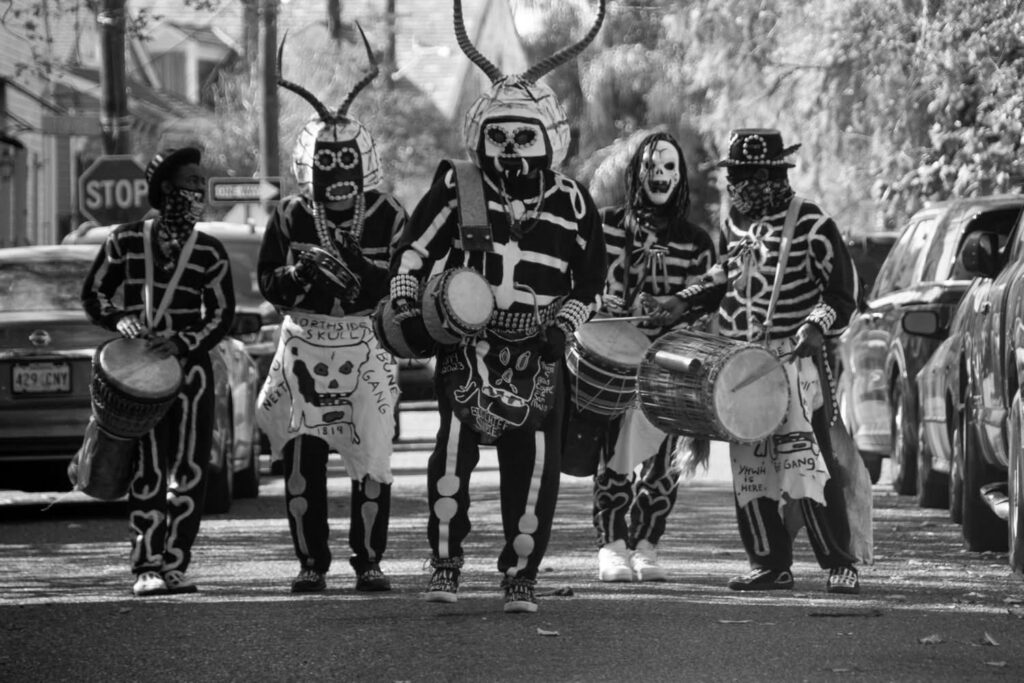
A friend sent me a link to a small krewe in the Tremé district that claims to go back 200 years. Well, maybe not, but maybe. In 1827 Mardi Gras was a thing for real, this is the year it is first recorded. This krewe mask as skeletons, wake people up early in the day, before sunrise, to remind them of the fate that awaits us all. They play (today) right near where Marie lived (then). So it’s perfect, and it has the right attitude of playful disrespect, waking people up at 5 AM.
For context, the free people of color and the white Spanish, and later French, lived (more or less) side by side with little problem, until the Americans showed up. Slaves, well that’s an entirely different horror. Nonetheless, by 1827 segregation has started. So celebrations in the “back” of the city, like the (then) new Tremé district are perfect. Marie and her Gran can watch the revelry walking by their house.
So a bit of history is here: https://www.history.com/this-day-in-history/February-27/new-orleanians-take-to-the-streets-for-mardi-gras
History says that 1827 was the first celebration. It had existed in the 1700s, but The Spanish outlawed it. “After Louisiana Territory became part of the United States in 1803, New Orleanians managed to convince the city council to lift the ban on wearing masks and partying in the streets. The city’s new Mardi Gras tradition began in 1827 when the group of students, inspired by their experiences studying in Paris, donned masks and jester costumes and staged their own Fat Tuesday festivities.”
Men of color (either independently wealthy or the children of rich white men and Black mistresses) often went to Paris for education. So what was the experience in France?
AHA! Don’t you know, I wrote four novels of the Enlightenment, up to 1650. There is a tradition, associated with the day of Mardi Gras, that exists to this day. It is called the Bazoches. Revelers “capture” the wealthy and force a “donation” to a charitable cause, a ransom of sorts. All in good fun and good humor, the wealthy are arrested, put on “trial,” and forced to pay to get out of jail. For absolute real this happened in New Orleans in the 1800s. So I’m going to put the two together.
What we have in 1827, says I the fiction writer, is the blending of the wild, raucous French bazoches tradition with dancing in the streets in the back of the city.
Says the link, “The parties grew more and more popular, and in 1833 a rich plantation owner named Bernard Xavier de Marigny de Mandeville raised money to fund an official Mardi Gras celebration. After rowdy revelers began to get violent during the 1850s, a secret society called the Mistick Krewe of Comus staged the first large-scale, well-organized Mardi Gras parade in 1857.”
Another link to history: https://www.atlasobscura.com/places/starting-point-of-the-first-mardi-gras-parade-new-orleans
“Under gaslit torches in New Orleans’s warehouse district, a Mardi Gras tradition was born. At the intersection of Julia and Magazine Streets, the Mistick Krewe of Comus kicked off Fat Tuesday with a parade that marched through the main thoroughfares of the city to the Gaiety Theatre, on Gravier Street between Carondelet and Baronne Streets.”
That was in the “whiter” and more upscale part of the city I suspect, just before the Civil War. I may get there, this novel will reach to 1859. So perhaps that first formal “parade” will make it in. Maybe not. I like the quieter, rowdier, back-of-the-city atmosphere where real people live.