In The Flow of Time – August 24, 2024
How history makes it into fiction.
I can’t write a novel in this time without at least mentioning a pivotal battle in the history of the United States. Yes, it happened after the peace treaty had been signed, before anyone involved knew about it, and long before it was ratified. Nonetheless…
This isn’t a war story, but the battle is a major event for our characters. Charles “Don Carlos” Trudeau’s youngest daughter Manette, a nurse caring for the British injured after the battle, met Dr. Josias Kerr, an Irish doctor. They fell in love, got married, and are in the story because, unlike the rest of her family, she’s not a racist. They will be woven into the story, and this battle brings them together.
The antagonist, Manette’s uncle René Trudeau (a slaver), is a cavalry captain, leading the St Charles Troop of Horse (all the white plantation boys). Other characters are members of Ogden’s Dragoons, General Jackson’s mounted bodyguard. Yet another is his aide de camp. All of that is real. Putting this in the story allows me to introduce them. The POV for the battle will be René Trudeau. Lucky for the author, who loves to be historically accurate, there is no record of where his unit was on the battlefield. So I can make up anything I want.
Happily, I’m not writing military history. A quick review of high level sources shows that they, at least in part, disagree about what happened that day. What, the chaos of a battle 200+ years ago? Whodathunk.
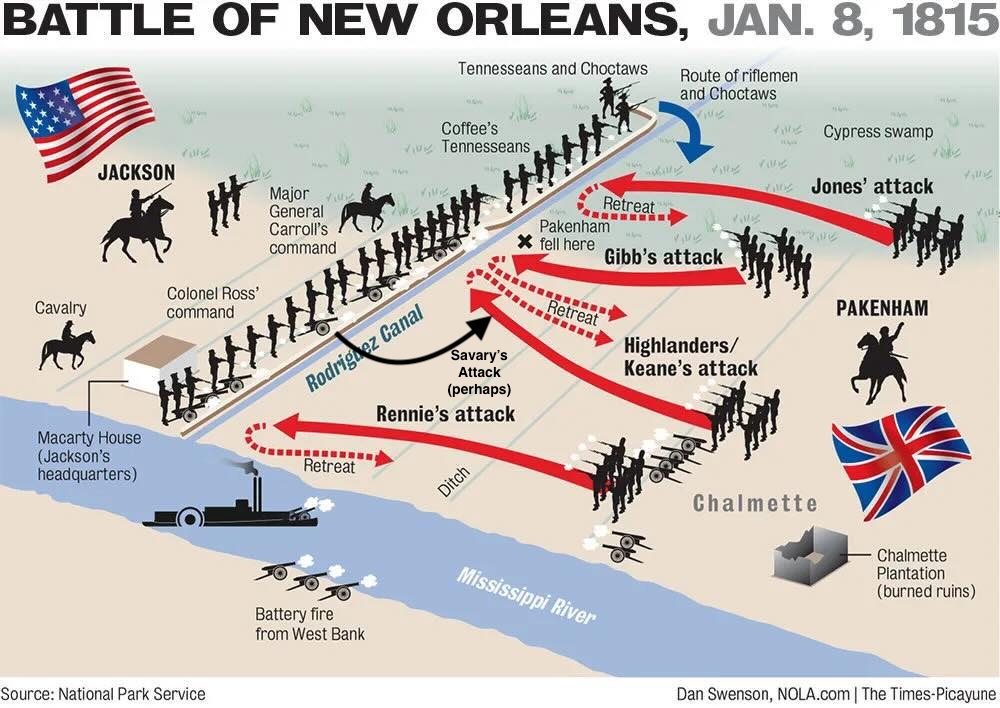
For the most part, this was the British marching across an open field toward the American line. That line was behind a disused sawmill raceway, about four feet deep, about four miles from New Orleans. And a defensive rampart designed by Barthélemy Lafon (a character). The Americans had substantial artillery (especially from the Baratarian pirates) and just blew the shit out of the British. “When the smoke had cleared and we could obtain a fair view of the field, it looked at first glance like a sea of blood. It was not blood itself, but the red coats in which the British soldiers were dressed. The field was entirely covered in prostrate bodies.”
Doing the math, the Americans suffered about 70 casualties. The British, more than 2,000. Ouch. Why so lopsided? British incompetence. There was a lot, including a frontal assault across open ground against well-defended artillery positions.
Andrew Jackson knew they were coming, and that he was outnumbered. Well in advance he apologized for the American attitude toward the free people of color, and invited them to sign up with a promise of 160 acres to each man. They did, several hundred free colored men from New Orleans. There were two battalions of Black men holding the American line. I have battle maps, I know where they were.
Of course, all the senior officers were white. Joseph Savary, Captain Commanding, of the 2nd Battalion, was the exception, a Black man, a refugee from Saint Domingue. At the time he was the highest ranking Black officer in the US military. He had Black non-coms. The officers had uniforms. The enlisted men wore civvies, no time to get uniforms. His formal commander was a man named Daquin. That white man doesn’t show up. Savary does.
Here, the history from different sources diverges. One source notes that “the battalions of Plauché, Daquin, Lacoste, along with three quarters of the 44th US Infantry did not fire at all.” That may be, but it does me absolutely no good. This is fiction, what I want is a glorious resistance by Black troops, Rene Trudeau riding hard to their reinforcement, only to discover he isn’t needed. Well, the British never attacked the part of the line defended by the Black battalions.
The weight of the British assault was further away from the river, toward Savary’s left. A literal handful of the British actually reached the American line over there. Most died in their hundreds because of an awesome example of bad leadership. We meet Lt. Col Thomas Mullins of the British 44th Regiment of Foot. He sends his unit forward to attack the ditch, having failed to provide them with the ladders and fascines they need to get across. Failed? The sources say “he forgot.” That’s how it’s described. The idiot sends his men into battle without the equipment they need.
The Major General in command of all British forces finds Mullins hundreds of yards to the rear! Livid at the incompetence and the lack of leadership, General Pakenham, on horseback of course, heads to the front to take charge of the assault.
Says one source, American grapeshot took him out. Again, that doesn’t do my story any good. But others, including Andrew Jackson himself, say it went like this.
Captain Joseph Savary, his men in defensive positions behind the ditch, sees what’s developing. The main weight of the British assault is to their left, and indeed they are getting close to the ditch. He seizes the opportunity presented by the chaos of the moment. No one is anywhere near his position. He leads his men across the ditch and into the open battlefield. I’m not making this up, this is detailed in some of the sources. Looking at the maps, he is attacking the British assault from the flank. Riding up to lead that assault, Major General Packenham. One of the 2nd battalion shoots and kills the Major General. Jackson himself gives the unit credit for the kill.
Having lost their most senior commander, the assault falls apart. The reserve General sends in troops to cover the retreat. While the artillery fired for a few hours, the “men with guns trying to kill each other” lasted less than 30 minutes. And when it was over, the field was covered with dead, dying, and injured British soldiers. Because, absolute incompetence.
For the story, what I might do is… René Trudeau, from his position in reserve near the ruins of the Macarty plantation house that is Jackson’s headquarters, sees a hole appear in the American line. His unit is the rapid response shock troops to respond quickly to changing circumstances. He rushes with his troop to fill the gap, and minutes later when he arrives, Savary is coming back across the ditch. “What are you doing here? Don’t need you. Go back to your lily white horse parade.”
Savary is like that. Jackson ordered the Black troops to do the shit jobs beneath a white man. Savary ordered his men to ignore the orders. It was against the law for them to participate in the victory parade in New Orleans. He marched his men anyway.
What really happened? Who knows. But I’ve got enough for this little bit of my story. It’s one man, one little moment on a chaotic battlefield, and proximity to reality is uncertain. This is fiction.
But men like Savary win battles, and wars, for real.