Plus Ça Change – June 7, 2026
If you read no further, this tells you what to expect. These are the racist waters in which our characters swim. Slaves are livestock.
Art. 492 The children of slaves and the young of animals belong to the proprietor of the mother of them.
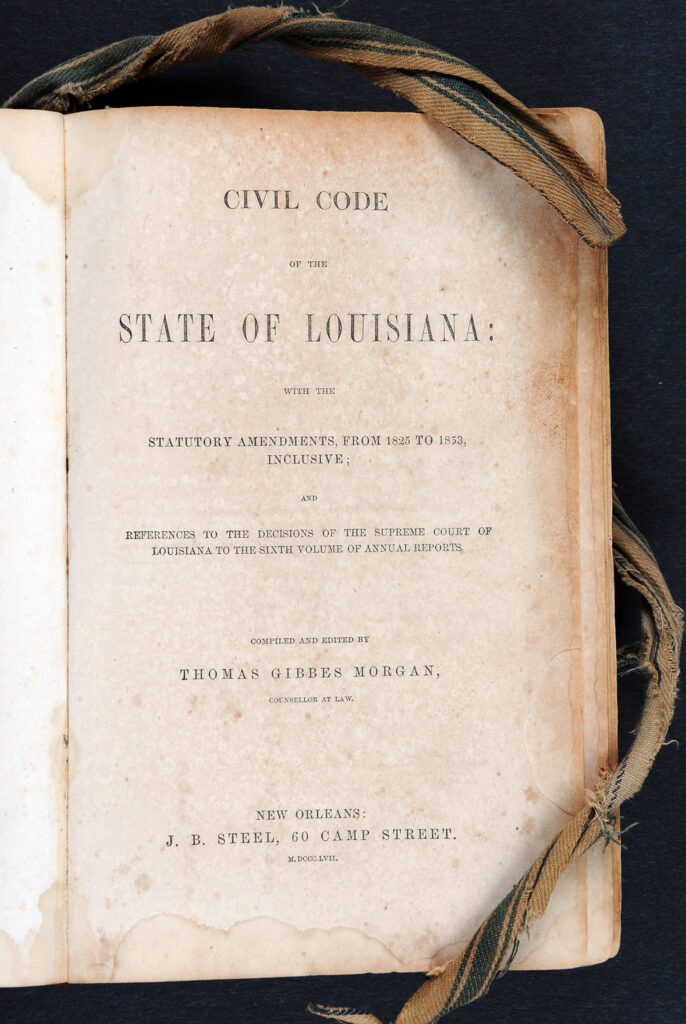
It’s Sunday, I’m off on a research rabbit-hole. What is the actual civil code in antebellum New Orleans as it pertains to Christophe and Marie? Legally, “concubinage” is unmarried people living together. This version of the Louisiana Civil Code dates to 1825. Americans are in the ascendancy. For upcoming chapters, I’m particularly interested in the law relative to…
- interracial marriages (slaves and free people of color) – totally illegal of course
- property transfers
- wills
What are the limits of bequests to the person you live with (concubinage), and the children of such a relationship? While never stated explicitly in the law, these are by and large interracial relationships.
Article 95 of the code says interracial marriage is against the law. It applies to a white person with either a slave or a free person of color. I am not surprised, I knew this. I just wanted the actual words.
It looks like, legally, a white person can live with a person of color, they just can’t get married. So I may need to do some adjustment. I’ve been operating under the belief that even living together was illegal. I will likely change that emphasis to “social ostracism.” That’s historical, in more than one case someone who claimed to be white was outed as having Black ancestry somewhere back a ways, and became outcasts. More than social disdain, there are serious legal consequences.
All of this applies to Christophe Glapion (white man) and Marie Laveaux (free woman of color). In the story Père Antoine marries them secretly, but that’s fiction. The truth is, she lived with the man for the rest of his life, they had seven children—two of whom survived to adulthood—and had the life that a husband and wife have. He legally acknowledged their children, so the law calls them his “natural” children as opposed to legitimate, or bastards. But they are children of concubinage, they are not legitimate.
All this causes significant problems, for real, to the family. The law is severe.
- Neither of them can transfer “immovable” property to the other (this includes slaves)
- Any transfer of “moveable” property is limited to 10% of the value of the estate
- He cannot bequeath more than 25% of his estate to his “natural” children
- Any such bequest cannot be immovable property, it must be moveable
Marie owned a property in the Marigny district (her dowry from her father). In the end, Christophe owned their home on Rue St. Ann. She could leave her property to her kids, but he couldn’t. So if he dies, the family is out on the street. Most of his estate belongs to his “legitimate” (read white) relatives. His white relatives could claim, since he is “the man” in the relationship, that her property is his. There is no pre-nuptial that says she keeps hers, they can’t be married.
For real, Marie and Christophe went through some serious real-estate legerdemain to keep their home and her property in the family. What they—and others—did is rely on a trusted intermediary. Christophe gifts or “sells” the house to a family friend, a man of color, because this man is not his concubine. That man gifts or “sells” the property to the children. Christophe accepts the gift on behalf of his “natural” children. The house stays in the family because, legally, the KIDS now own it. It is not part of Christophe’s estate.
In the end, this nonsense paid off. When he died, his sisters went into the house, claimed everything of value that was his, and left Marie with his old clothes. But the family kept the house.