Plus Ça Change – May 31, 2026
Abraham Lincoln was flatboat crew in New Orleans twice as a young man, in 1828 and 1831. He really was a studious, serious young man. The author’s conceit is, he meets Marie in 1828. He’s puzzled by the strangeness that is New Orleans, sees her dancing at Place des Nègres, and comes back to strike up a conversation to get a local-eye-view on this (to him) bizarre culture.
He’s back. It’s 1831. So why do it again? Because it serves the narrative. Abe is a fabulous vehicle for discussing interracial relationships, and oppressive politics. He is (was) a genuinely open-minded and very intelligent young man, already interested in the law and politics, and prone to talking with anyone about anything from all sides to blend the best ideas. The legend is based on reality. Much has changed in the three years, and he sees it. He comes back to the well to learn more. On his second trip he is much less the wide-eyed bumpkin.
I am once again in debt to the non-fiction title, Lincoln in New Orleans by Richard Campanella. But this time, we’re going to take some fictional liberties so I can tell my truth.
Facts
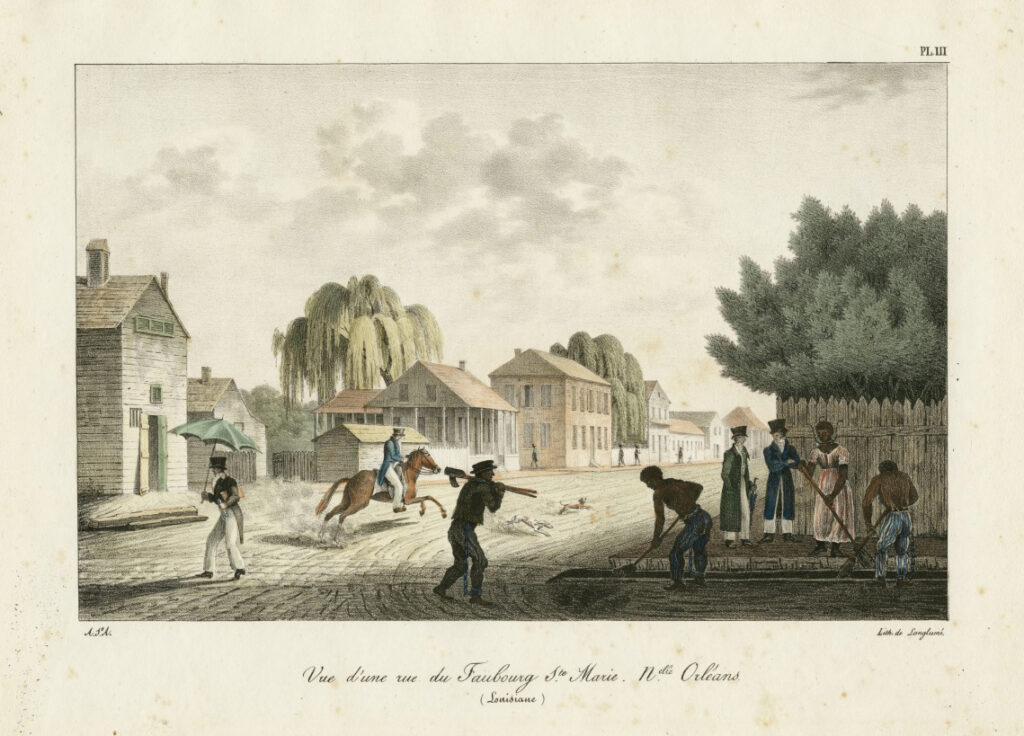
Based on research, Campanella pegs Lincoln’s arrival about May 12, 1831. He’d be occupied for a week or so with the crew selling cargo, tearing down the flatboat and selling the lumber. So he’d be bouncing around town about May 20, 21, for a couple of weeks thereafter, before heading home on a steamboat. In detail we know nothing specific about Abe’s visit. But we do know what the world was like: slave auctions at Hewlett’s; dozens of tall ships; about where he landed; what the usual routine was, etc. The good new for me is, I actually don’t care about those details. The color of New Orleans is throughout the novels.
For real, Lincoln had a recurring dream throughout his life, that—to him at least—seemed to appear before momentous events. That dream is going to show up, and be the basis of…
Not so factual, Campanella relates the legend that Lincoln visited a Negress fortune teller on this trip. The fortune told is almost certainly bullshit, but this is the basis for “so he finds Marie.”
Marie gave birth to baby son Christophe on May 13. The baby died May 21. She would clearly be in mourning. Marie’s Gran Catherine is dying. She dictated her will to a notary on March 19, who found her “sitting in a chair, ill in body but sane in spirit and memory and understanding.” Catherine died on June 18. This is the woman who raised Marie, so emotionally this is mom. Catherine had a long and full life, it’s not the death of her baby, but talk about piling on! Sheesh.
Fiction
Given the emotional heaviness for Marie after the middle of May, I’m moving all this to the first Sunday in May.
Abe goes looking for Marie, but she’s not dancing at Place des Nègres. He knows where she lives, shows up unannounced at her door. All the death is in her future. She knows Gran is dying. Gran will be napping. Uncle Joseph will be out hunting. Marie is nine months pregnant, which explains her absence at the Square. It’s just after lunch, and the conversation will happen around the table. Based on other anecdotes about Abe, this is precisely the kind of place where he would be very comfortable. It’s the setting, not the race, that matters to him.
Somewhere in here, likely at the very end of the chapter, he’s going to ask Marie about his dream, and what it means. That is as close as we’re ever going to get to fortune telling.
Writing
These choices keep the conversational participants to a minimum: Marie, husband Christophe, Abe. Christophe does the translating, because Marie speaks Kouri Vini, Abe speaks English. Christophe is multi-lingual.
I’ve discussed alternative approaches with my darling first reader. I thought I’d have her Popa here to argue politics, but that’s a needless complication. She can relate her father’s beliefs if that shows up.
That was last night. I have a conversational flow. I have it in hand, and started the opening this morning. There are lots of possible topics: the laws governing interracial marriage; restrictions on movement in and out of the state, death penalty for creating discontent among Black people; segregation; politics and her Popa’s politics; her personal life, babies, Gran; the legality of her relationship with Christophe a white man; oppression; the impact of all this on Abes concept of “the Black Mechanic.”
I will spew all this out in a “talking heads” convo among the three of them. Then I will go through the entire mess, move pieces around, make it flow like a real conversation, tighten it up, hammer off the dross, and add in the “beats” that make it human. I will bring you to the table where you can sit and watch these fascinating people talk about the reality in which they live.
This is gonna take me a few days 🙂
All of it is true, but it’s not all factual. It is extremely likely that Abe saw Marie dance in 1828. That he saw her in any way during 1831, nope. It’s not impossible, but it didn’t happen. I still want to use this outstanding opportunity to reinforce the truth of the growing oppression of people of color. But, I need to play with the facts.
Abe shows up in New Orleans a couple of weeks earlier than he did in history. That’s the only change to history. I’m OK with that. It’s. Fiction.