Plus Ça Change – August 16, 2026
The scene: Marie goes to the night firewood market to get fuel for her kitchen stove.
There really was a night market for firewood. It really was in the neutral ground on Rampart Street near Canal. Night because the people selling firewood were runaway slaves, marrons (maroons), and darkness is a good thing. It happened where it did because the marrons lived in the cypress swamp behind the city, and this location was the closest place in the city where you could have an impromptu market.
Except it wasn’t that impromptu, it happened most nights, and (as best I can tell) the police ignored it. The vendors are criminals, and everyone closes their eyes because everyone needs wood. I suspect that wood was cheaper here than from a “reputable” dealer. There are ads for firewood in the newspapers.
Why is this in the story? Because it’s part of Marie’s world. Slaves ran away all the time. Some went north, some went to Mexico, and some lived free in the swamps, and did so for years. There was an entire economy built around them, and a key element of that was firewood. I’m planning four chapters about the marrrons, might be three. This is the first. So let’s make it realistic.
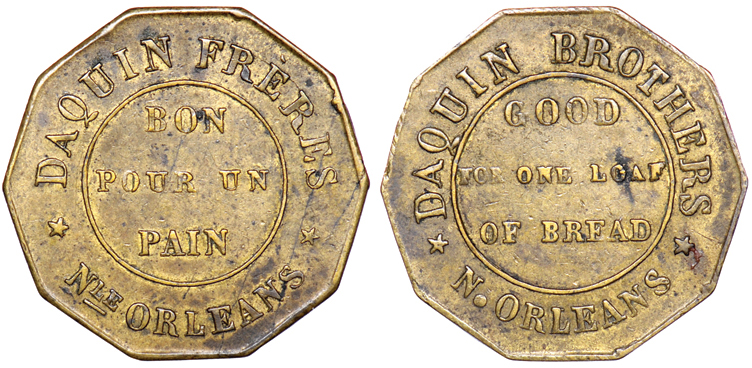
Wonderful. So Marie goes and buys some wood. But it’s 1837, the economy has crashed, crashed so hard that paper is worthless, and real coins are scarce. As a result, self-help. Businesses produced their own coins, nowadays called Hard Times Tokens. They were common in all the major cities in the United States after the 1837 panic.
Some closely mimicked real coins, even leading to charges of forgery. They were brass, alloys, even copper. I think most of them operated as pennies, which had significant value at the time. Many were about the same size as the large penny coin (about an inch across). One said “Not a Cent” as a play on “Not one cent for tribute” and because it was, indeed, NOT a real penny. Some merely identified a company, but were treated as a coin of value. Some were advertising, we sell… Some were chits one step away from barter. Real currency was scarce, so these fake coins became currency.
I found one from a bakery in New Orleans, the token is good for one loaf of bread. But now I have a problem to research. In a barter economy, what’s the relationship between a loaf of bread and a bundle of firewood? How many “loaves of bread” as fake coins will Marie need to fill up a wheelbarrow with firewood? Turns out, a loaf of bread is about twelve cents. A wheelbarrow of firewood costs about twenty-five cents (based on the price for a cord of wood). So Marie will pay two “one-loaf” tokens for a wheelbarrow of dry firewood. The bakers are more reliable than the banks, and when you redeem the coin you don’t get bullion, you get something to eat.