In The Flow of Time – September 9, 2024
I’m deepening my background on the ancestral roots of African religion to which Marie Laveaux is plausibly exposed. There are three major areas where people were stolen from Africa. Modern day they are Senegal-Gambia; the Bight of Benin, and the Congo. Each has its own languages and religious belief systems.
Plausibly, Marie’s maternal great-grandmother was a member of the Wolof people from Senegambia. Her paternal grandmother was from the Kingdom of the Kongo. She does not have direct roots into Benin, which is the source of most Haitian Voodoo. But literal thousands of Haitians were exiles in New Orleans in the early 1800s, bringing their version of the evolving beliefs. So in one form or another she has all three traditions.
Each of these traditions is closely tied to health. Poor health means you are misaligned with the spirits. The spirits are analogous to Christian angels or saints. In fact, in many cases a specific Voudou entity is directly aligned with a Catholic saint. Voudou believers knew them to be the same, just expressed in a different language. There is a female water spirit in each culture. We have Mami Wata (New Orleans), La Siréne or Erzulie (Haitian), Yemoja (Benin) and Simbi (Kongo). We can hide our belief in them behind veneration of the Catholic Virgin.
Spirits are not just the gods, they are your ancestors. So if you’re sick, you go to the healer (potions, herbs, plants, etc), have a consultation, figure out who you’ve pissed off, and… in the case of both the Senegambia and Kongo traditions, you get a “magic” amulet. It’s filled with the proper powders and substances to realign you with the spirit world. In the Senegambia world, these are gris gris. In Kongo, minkisi. Mindless superstition? No more than wearing a crucifix on a chain around your neck. And a whole lot more sane than wearing a cilice (look it up – some people are just plain nuts).
Oral tradition says that Marie Laveaux was a masterful gris gris conjure woman, and an astonishing healer. Mami Wata is known to bestow deep insight, and Marie had that. In the novel, she learns these skills from her grandmothers. All of these various traditional names and concepts, in her world they are one and the same. All while going to Catholic church every Sunday. She is the synthesis of multiple cultures, languages, nationalities, races, and religions; at least three of each, in most cases four or more.
Savages? The cosmogram represents the world view of the Kongo peoples. It has the circle of life, each with its colors. The river runs through it.
“The Kongo people also believed that some ancestors inhabited the forest after death and maintained their spiritual presence in their descendants’ lives. These particular ancestors were believed to have died, traveled to Mpémba, and then were reborn as bisimbi. Thus, The Great Mfinda existed as a meeting point between the physical world and the spiritual world. The living saw it as a source of physical nourishment through hunting and spiritual nourishment through contact with the ancestors.”
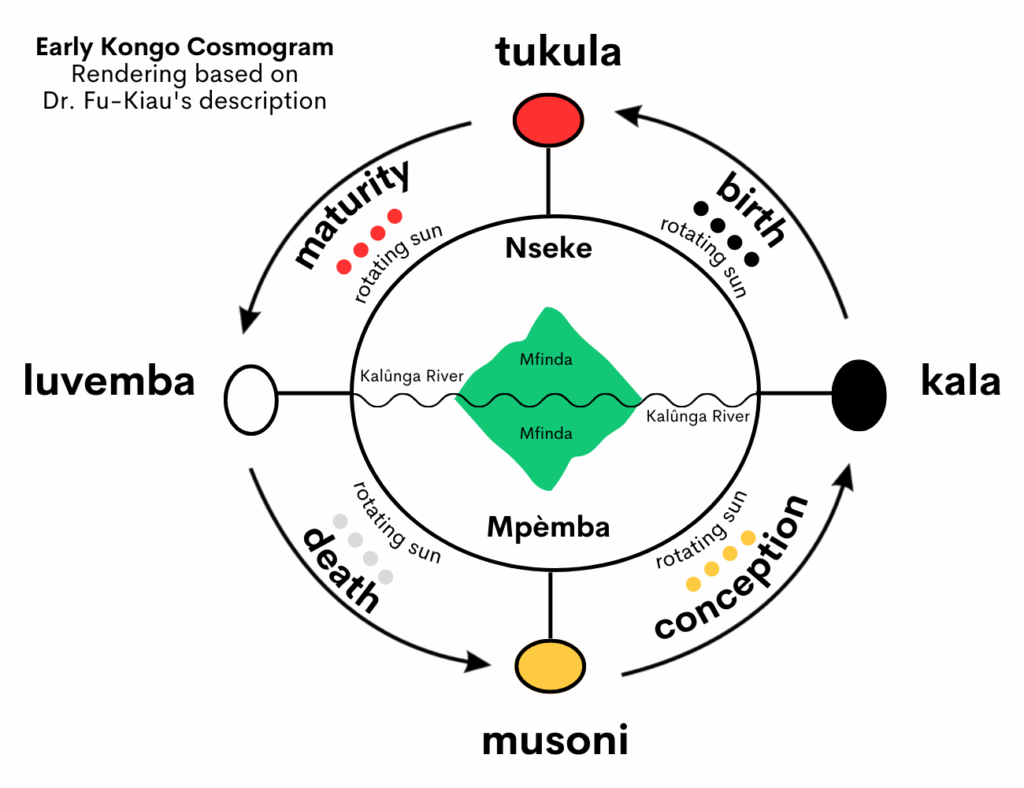
The Mfinda is the “sacred grove,” the forest where we all live and experience, and where our ancestors remain after they die. It is the center of everything. I think all religion is nonsense, but this one is one hell of a lot healthier than white man sky god hierarchies of angels, thrones, and dominations.
Oh, and it all started with a Big Bang.
“The Bakongo believe that in the beginning, there was only a circular void, called mbûngi, with no life. The Great Spirit, Nzambi Mpungu, summoned a spark of fire, or Kalûnga, that grew until it filled the mbûngi. When it grew too large, Kalûnga became a great force of energy and unleashed heated elements across space, forming the universe with the Sun, stars, planets.”
Are there savages in this story? Yah, the bastards turning these people into slaves.