In The Flow of Time – September 12, 2024
Spoiler alert, in which the end is revealed.
(Edit: Because this turned out to be two books, this will be the end of the second novel, or maybe not the end, maybe the prologue, or maybe a prologue to Dancer. 🙂 But this is where I was as the story developed.)
There are a lot of ways to tell a story. I’ve written the opening chapter of the New Orleans novel, and I chose present tense instead of past. It pulls you in, there is a sense of immediacy. “A coffle of slaves tops the levee, walking toward the city in the synchronized cadence forced by their chains. Marie remembers the smell of the pens along Esplanade, and shudders.”
This is not first person. This is about Marie, not told by Marie. There is still a story teller. Present tense is demanding, but I’m up for that. We’ll see how it goes.
When I write I like to know where I’m going, hence my love of plotting. I have a possible ending, a pretty cool scene where I can really wrap things up. It’s in St. Louis Cemetery #1. I’ve got the maps, which families have which tombs, So I sorta know where I’m going. It all fits in with what Marie was really doing in the later years of her life, after the Civil War.
Ah, but who is the story teller? In most novels there is no story teller, it’s just the author. That works. But maybe I want a story teller.
From an African perspective, the person telling the story would be a griot, and I wonder, can I put a griot in the story? How? Probably won’t work. But… shit man, this has appeal. “Call me Ishmael.” But… nah. I’m covering 50-60 years. Sticking a story-teller as a character in the middle of this isn’t going to work. It would be an artifice, clumsy. The griot is me. I’m the one telling the story.
BUT… the idea doesn’t go away. Plot. Plot. Plot. The back of my head wonders… who is the story teller? I think I’ve got a way to do it, and it works.
Here’s the ending. It’s sometime between 1865-1870, during Reconstruction. As an older widow in her 50s, Marie ministers to men on death row (real). She knows one is innocent. Knows. So she conspires to help him escape. She makes his last meal, a gumbo laced with the “zombie poison.” This is a real thing, and she would know how to use it. He’s a minor character, complete fiction, Jude Rabelais. The scene is a vehicle for Marie to demonstrate her final synthesis. She has given up changing the world, she works small scale, one at a time. Jude is found dead in his cell, avoiding the gallows. She accepts responsibility for the body and entombs him in one of her vaults. (She has two, she really did.) She comes back that night, full moon, to let him out. Having worked her magic, she sends him on his way into the nearby cypress swamps to escape. THE END.
Not the end. It is forty, forty-five years later, 1911.
The epilogue begins with the identical words that ended the story. A wizened old man sits across the table from you. That this has all been a tale told by a griot is now clear. He has finished the story.
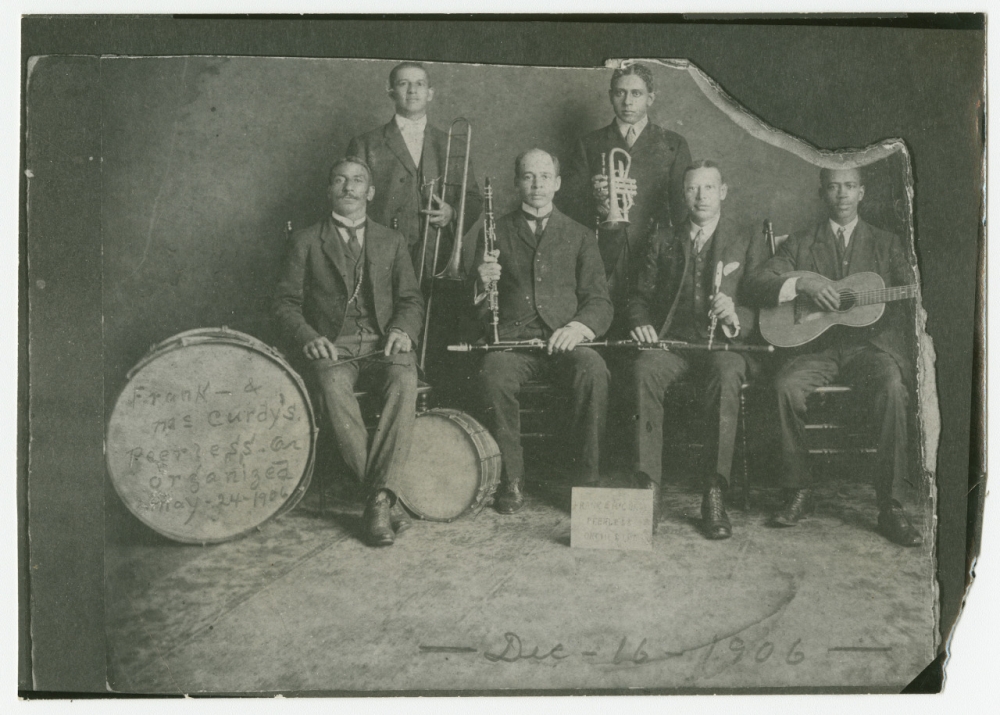
You are in Economy Hall. There aren’t gas lights, or moonlight. There are electric lights! Kid Ory hires the hall every Monday for his jazz band. You enjoy the music as people dance on the floor. Perhaps it’s a different night, with the house band. Sidney Bechet, a 14-year-old prodigy, floats a lyrical melody on his clarinet. The notes are gift wrap around the words the griot has given to you.
But the story he has told you, the details, these are things he cannot possibly know. You ask, How can you know all this?
He tells you of the gift. He recounts, very briefly, his long night in the tomb; his vision of Mami Wata, her gifts of foresight, hindsight, insight. The door to the tomb opens, it is Marie, with the gift of his life. The griot looks you in the eye and says, “I have come from the grave to share this gift with you.”