In The Flow of Time – August 16, 2024
I am starting to plot, which really means, I’m making up a story. It’s fiction! I have this truly massive pile of facts that exists in and around antebellum New Orleans. I’ll make stuff up or move stuff around to stick to the truth of the tale, to make a better story, but I really do like knowing what the weather was on a given day. If I can build on real facts, I’m happier.
I’m writing the arc of Marie Laveaux’s life, and a real oddity appears from among the facts. It’s along side, not central. But it is a conundrum at which I chew. Bear with me on the names and length. To me this is a FASCINATING story of slavery as it really was, how it appeared in the daily lives of the perpetrator and the victims. This is the story of Benedicte dit Robinette, both fact and fiction, how she escaped slavery, and then was forced by law back into slavery. Her tale has gripped me since I discovered it in the records, and my relatives are all over it. For the story, she will be simply Robinette.
Don Carlos Trudeau is Marie Laveaux’s grandfather. Zénon Trudeau is Don Carlos’s brother, and René Trudeau’s father. Zénon is a very wealthy sugar plantation owner with ~90 slaves, one of the largest in the Parish, a few miles upriver from New Orleans. He is married to Eulalie Trudeau (Delassize).
One of Zénon’s many slaves is Charlotte. Charlotte is a house slave, probably a cook. She has a daughter, Robinette. Charlotte is Black. Robinette has a white father. Robinette was born about 1789-1790. (Plausible fiction: Robinette is Zénon’s daughter.) About 1801, Charlotte is sold. Robinette remains on the plantation, in the house. She was old enough, this didn’t violate laws against separating mother and child.
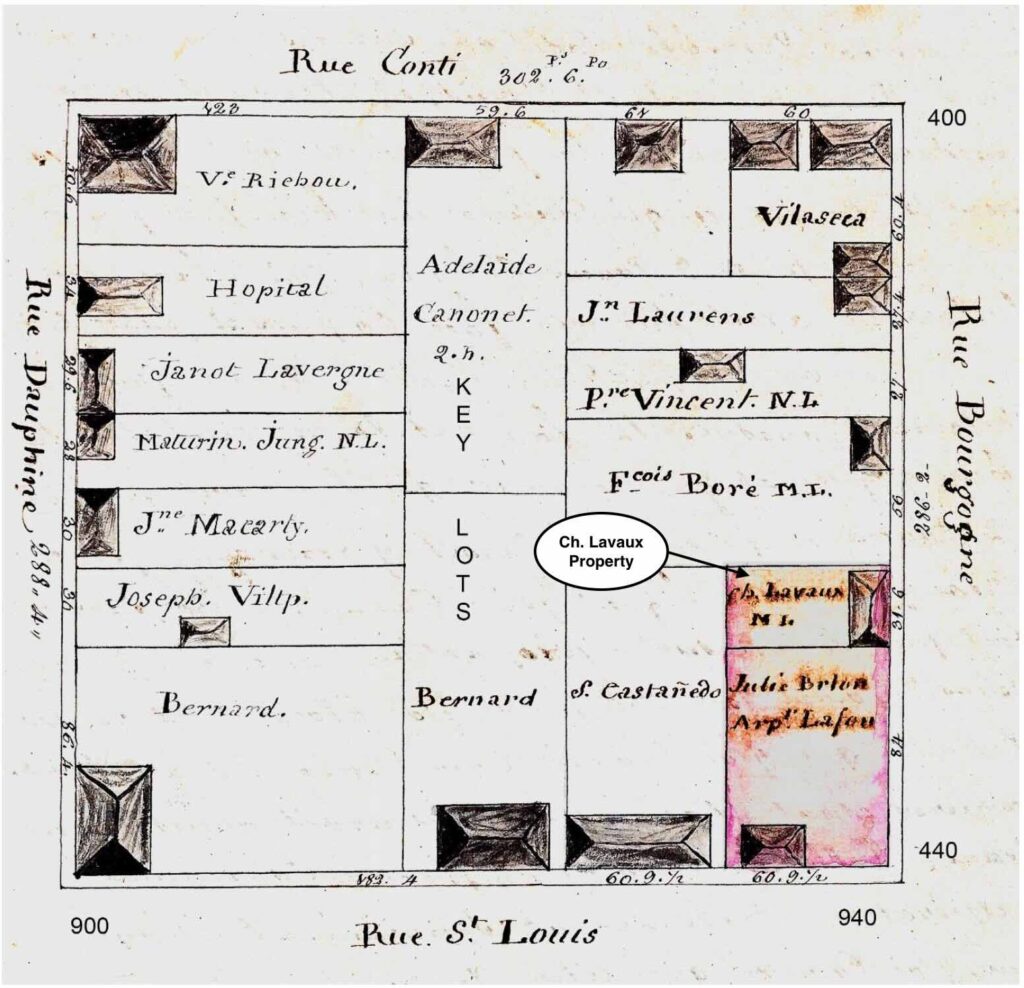
Sep 13, 1804, Charles Laveaux, free man of color (Marie Laveaux’s father) buys 424 Burgundy Street (modern address) from the estate of a wealthy free woman of color, Julie Brion.
December 10, 1804, Charles Laveaux sells 424 Burgundy Street to Charlotte Brion, a free woman of color. This is Zénon’s former slave, now free. (Plausible fiction: Julie Brion owned Charlotte, and emancipated her in her will. That’s where Charlotte’s surname comes from. Someone emancipating their slaves upon their death was fairly common.)
Oct 11, 1808, Zénon writes to Joseph Gardette about selling Robinette. These are his words.
“Robinette, a child of my house having always acted in a manner different from that of girls of her color, I am happy that she finds the opportunity of securing her happiness, especially at the eve of the day, when her young mistress is under the necessity of calling her back near her, or of replacing her.”
Not important, but the “young mistress” is Zenon’s daughter Aurore, to whom Robinette was servant. This also implies that Robinette is already out of the house and living with Gardette (“calling her back…”)
March 20, 1809, Robinette is sold to Joseph Gardette, along with her 4-year-old son Prosper. I don’t know who Prosper’s father might be. Years later testimony says that Gardette is the father. Robinette changes owners a couple of times, but Gardette appears to be a stable relationship, a sort of plaçage, although she is slave, not a free woman of color.
On Sep 10, 1811, Charlotte buys her daughter Robinette. (Plausible fiction, Robinette moves in with Mom at 424 Burgundy Street, maintaining a relationship with Joseph Gardette.)
On July 21, 1812, Robinette is emancipated by her mother. Robinette is 24. Although this happens, it is illegal. The law requires that a slave be 30 before they can be emancipated.
On Sep 12, 1813, Zénon dies. Eulalie is his widow. His oldest son René is executor of the estate.
So far, all of this, as evil as it is, is normal.
On Nov 15, 1814, Charlotte Brion sells her house to… Eulalie Trudeau, Zénon’s widow. ???????
OK, back to normal.
On May 2, 1815, René files suit in court to repossess Robinette. At some point he has her arrested, she gets out on a habeas corpus, they go to court. He has a lawyer. She has a lawyer. His lawyer is Alfred Hennen. Her lawyer is August Davezac. Davezac is somebody, this is not cheap. René wins. Davezac gets a new trial. At the 2nd trial, Robinette wins, a jury declares that she is a free woman. René appeals.
On Jan 21, 1817, the Supreme Court of Louisiana declares Robinette to be a thing, and she becomes René Trudeau’s slave.
On April 19, 1817, Robinette and her four children are sold to a man named Antoine Abat for $1500. He has dozens of slave transactions, buy and sell. He bought Robinette before, on her way to emancipation. Hmmmm…. We have zero information about her three youngest children. The seller is a man named John Nicholson. (Plausible fiction: both of these men are agents for others, perhaps lawyers or factors, acting on behalf of the real owner. That happened all the time.)
Twelve years later, on July 27, 1829, Eulalie Trudeau, Zénon’s widow, sells the property at 424 Burgundy street to Marcelite Trudeau, a free woman of color.
Those are historical facts, with a couple of plausible interpretations. The mystery is, why would Eulalie buy and sell 424 Burgundy Street? These are the ONLY real estate transactions in her name in the Vieux Carré. I looked. I’m an insane researcher. There is NOTHING ELSE. This makes no sense.
THE PLOT THICKENS
Yesterday it dawned on me, a story that makes this all plausible. This subplot fell into place and conveys a possible (and awful) family dynamic behind the evil that is slavery. Perhaps, Eulalie hated Zénon, found him disgusting. All very polite and proper, but this man is an over-empowered bastard who fathers children among his slaves. Eulalie is a smart woman, she knows Charlotte has no choice, no ability to resist. Robinette is a wonder, a charming child, sweeter than her own daughters. Eulalie actually LIKES Charlotte and Robinette far better than she does her husband. Robinette is as a daughter to her.
Her attitude toward her son René, he is his father’s son. He is a cavalry colonel, a big man, the white planter (he has his own plantation), he was Zénon’s favorite, and as big an ass as his father. No sooner is Zénon dead than he goes after Robinette. By this time Robinette has been officially free for years, and effectively free for longer than that. She has a family, multiple kids. For part of this time, she’s pregnant. She had already been sold off the plantation, but René can take advantage of the law and get her back, get more.
Through agents, quietly and as much as possible anonymously, she buys the house at 424 Burgundy, transferring thousands of dollars to Charlotte. She allows Charlotte to live there for free. And Charlotte now has the funds to hire a lawyer to protect her daughter. For Eulalie, she gets to gig the memory of her hated husband, and fuck with the plans of her hated son.
(Edit: Eulalie being kind to her former slaves didn’t survive in the story. Way too implausible, and not at all how life was like. She treated them like the things she knew they were. She can buy the house for personal reasons, as a form of revenge against her son.)
The legal case comes out badly. Robinette and her family are sold into slavery. But are they? Well yes, René would see to that. But, why is Antoine Abat back in the middle? Perhaps something is happening behind the scenes.
I imagine that sometime after 1820, when Robinette is more than 30 years old, that she and her children are legally emancipated by whomever owns her. There are no records. The slave transaction DB stops in 1820, and the “Freed Slaves” DB starts in 1841, so the researcher can invent. This is where I can make up what I need to convey the truth of this horror.
Eulalie owns 424 Burgundy Street. Robinette has moved on, has a life with Gardette. Charlotte dies. Eulalie is getting old nearing the end of her life. In a final parting shot at her son, she sells the property for a pittance to Marcelite Trudeau, a free woman of color.
And who is Marcelite Trudeau?
Fact: I have no idea. She appears nowhere else but in the chain of title for this property. Fiction: She could be Robinette’s daughter, and although not by blood, Eulalie thinks of her as her own granddaughter.
In this fiction, Robinette is René Trudeau’s half sister (that’s actually very likely). René doesn’t care, she’s a thing. He sells his own sister into slavery for money. Marcelite would be his niece, although he would refuse to acknowledge it He wants nothing to do with those savages.
For Eulalie, she is engaged in a quiet, proper, oh so polite revenge to rub her son’s pretty white nose in the lives of the hated Black side of the family. Bless his heart. I suspect this one, this sale to Marcelite, she would do wide, wide open. This is her final FUCK YOU to her son, and a gift to her granddaughter to get her started in life. THere is nothing he can do about it.
All right. I think I can move on now. This one has really bugged me.
(Edit: I don’t know that Marcelite will make it into the plot. Eulalie Trudeau’s kindness is long gone. She is a mean and vengeful woman (modern filter); fulfilling her proper role as a white widow. Another equally plausible interpretation of the facts is that someone named Marcelite was Eulalie’s slave, completely unrelated to Robinette. Near her death, Eulalie might have emancipated this personal slave, who would then adopt the last name of her mistress/benefactor.)
The image is a survey from 1804, showing the property of Julie Brion, one part of which has been sold to Charles Laveaux. This is the house he sold to Charlotte Brion, the house that Eulalie Delassize bought from her former slave, and sold to a free colored woman named Trudeau twelve years later. The surveyor and architect, Barthélemy Lafon, lived with Julie Brion’s daughter Modeste. It was a small town. He may show up, you know, the neighbor next door. (Edit: Oh boy, did he!)