Plus Ça Change – August 27, 2026
Once again, the unexpected. Working on Laveaux: Mother, I reach a chapter that has serious nostalgia potential for Marie.
Fact: As of 1840, neither white people nor slaves could attend a ball designated for free people of color. Americans impose segregationist laws. The Economy and Mutual Aid Society, a self-help organization of free men of color, holds their first fund-raising extravaganza. It is January of 1841. They rent the Washington Ballroom and put on a dance. This society was founded by followers of Marie’s father, Charles Laveaux. The organizer and first president, Pierre Crocker, is Christophe’s business partner and a family friend.
Fiction: In Laveaux: Dancer I have Marie’s mother and grandmother actively involved in pursuing a concubine relationship for Marie. In New Orleans at the time, this was called plaçage: placement of young women of color with rich white Frenchmen. Marie learns ballroom dance and attends plaçage balls at the Washington Ballroom. (I’m ignoring name changes to this establishment over time.)
Narrative
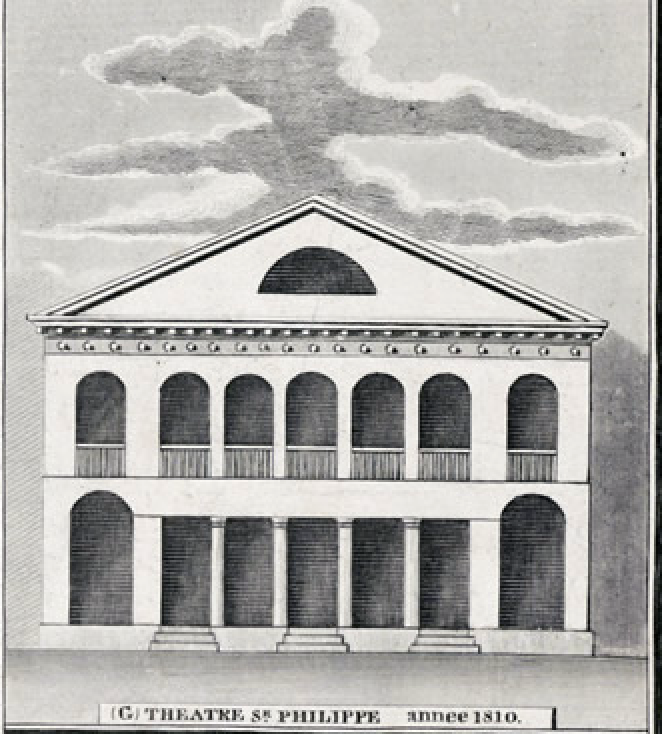
I’m going to have Heloise attend the 1841 ball, with her mother and father. She is fourteen. Christophe is white, but he’s passing as a free man of color so he can have his family with Marie. Pierre Crocker will be present of course, he’s a pre-eminent member of the mutual aid society. He is also (historical) Christophe’s business partner. So 25 years later, Marie finds herself in the ballroom of her youth.
And me, as writer-boy, well she and I are up in the ballroom together. It’s empty, there is no dance at the moment. She’s thinking about what happened to her in this room as a young woman. She looks to the balcony where she slapped the shit out of Thomas Kelty Smith, who grabbed her, tried to buy her as a whore for the night, pinned her against the balcony railing.
Except, she didn’t slap him. In Laveaux: Dancer she breaks free and walks away from him.
She is now a woman of 40, not a young woman of 17. This is not a pleasant memory, she’s actually upset at reliving it, but also proud of her choice. It was an emotional trauma for her, a moment that changed her entire life. Because of what that bastard did, she saw the truth behind the concubinage her mother was forcing on her. It’s whoring to a different price tag.
Except, a free woman of color striking a white man? Oh My God she would be in deep shit. There were thousands of “free” people of color, but they knew their place and it was subservient to whites. The social truth is, they weren’t really free; they were just “not slaves.” That’s not the same thing. There is no way she could get away with actually striking a white man, however much he deserves it.
But I did, says Marie. She remembers it.
Me as author, well I’ve learned to listen to my characters. On top of which, if she slaps him, that makes a better story. I’m writing 23 years downstream of the slap, and it happens to be in the same room, and as I think about this chapter, the memory of that slap has to be there. Because, it’s HER life, and she just told me what happened.
This is fiction. I know, I’m making it up. So yes, I can go either way with the “facts” here. BUT… that slap has emotional power. Marie at 17 takes a stand and refuses to accept either Smith’s assholery, or her mother pushing her to be a white man’s concubine. It is shocking, certainly to the white guy getting slapped. It gives him a (literally) striking memory that can inform his hatred, his desire to get back at her. It’s not a huge thing over the years, but it’s an added incentive for him to screw her any chance he gets. I think this is gonna make a better story.
Back into Laveaux: Dancer. Copy the chapter where the slap didn’t happen. Leave the original alone until I see if this works. Rewrite it so the slap DOES happen. There are lots of changes, who’s where, what happens, dialog, lots of stuff. All the reasons I put in place to NOT slap him, they’re still there, but she does it anyway. I figure out a very plausible way she can get away with it. She’s lucky that way. I look at the new version, yep, it works.
Marie escapes the consequences of slapping a white man, but I don’t. This event is central to her youth and independence. Smith becomes antagonist in Dancer, and is the only antagonist in Mother. He shows up again and again. I tweak four downstream chapters in Dancer, and three in Mother, before I get back to where I started. She doesn’t walk away, she hits him, and he deserves it. She carries the memory of the sting in her hand, and he carries the memory of humiliation at the hand of a woman of color! YES!
Now I get to finish blocking out what happens at the Economy and Mutual Aid Society ball in January of 1841, where Marie and Christophe share the coming out of their daughter into the social circle of the free people of color. Where Marie will reminisce about the twists that brought her back to this room. Where they will see Pierre’s interest in their daughter Heloise. Pierre is twenty-four years older than Heloise; Christophe’s partner; and already married with children.
It’s complicated.