Plus Ça Change – August 15, 2026
Once upon a time I was a tech writer focused on software development. I was very good at it. Company X would drop some new technology on my desk, and pay me to figure out how to explain it to the software developers who would use this fancy new toy. I got to see the new toys as soon as they emerged from the labs. No one ever taught me how to use the toy, and that was the key to the process. Learning on my own, I fell into every pit, then describe/explain how to NOT fall into the pits. This process is very mechanical. However complex or arcane, I’m giving you a procedure to follow.
How does that feed into writing fiction?
I don’t think of myself as particularly imaginative, although I suspect, in truth, I am. I really do, sometimes, have a complete imagined world inside my head, drop into it, and describe it. It’s not photographic, it’s impressionistic. I select the parts I want you to see, to manage your experience of the moment, and take you where I want you to go.
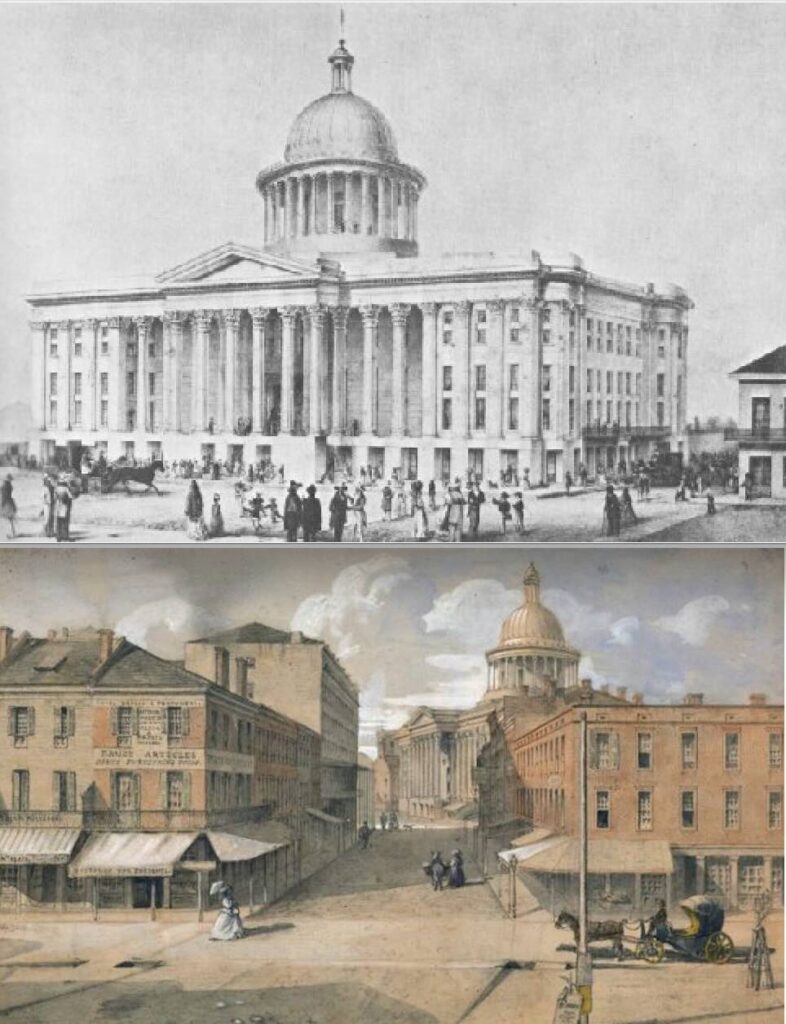
I’m also writing historical fiction. So if we’re going into the Saint Charles Hotel, or the Charity Hospital, or Reverend Clapp’s church, what did they look like, for real? If it still exists, what it looks like today may not be what it looked like then. So I research buildings and street scenes, and hunt for a period-correct reference shot: an engraving, a painting or sketch, an actual photograph. I’ll get words describing the building from the period, so that if there’s a bar on the ground floor, and it matters, I can walk you through the bar.
I do the same for characters. For any character that matters I have a visual of the person so I can describe them, and be consistent. Sometimes I can find an actual image of an historic person, like the Reverend Doctor Clapp. When I don’t have an actual historic image, well, I do have imagination. I’ll go find a reference from the universe that matches how I think of them. So there is an underlying “imagine,” but I have a visual I can describe.
In my vast collection of research are lots of pictures, sorted as people, places, things, and maps. I use those pictures to inspire my imagination, and make sure my descriptions are bounded in reality,
It turns out that the underpinning of tech writing and fiction writing is the same. I have some reality, I describe it to get you in the right spot.
BUT — The implementation of that process is radically different.
In the mechanical case, I write procedures. I guide you very carefully so you don’t fall into a technical rathole. And when you’re done, I want you to think, “How did I ever not know this?”
In fiction, “reality” is—at least in part—my imagination. You need to see it. That means I need to see it first. It might be entirely in my imagination, or an image that matches or fires my imagination. The output is lyrical, not mechanical. I transport you to a new world. And I want you thinking you just stepped into a time machine.