In The Flow of Time – July 7, 2024
One of today’s rabbit holes is the history of funeral parades, music, and the Second Line in New Orleans. This idea came from somewhere, it’s a tradition. I don’t know when that tradition was born. Most sources I’ve found take it back into the later 1800s, post-war. I am well before the war, antebellum, 50 years before jazz, so there will not be a jazz funeral, per se.
BUT…
Marie Laveau, for sure, presided over the music and dance at Congo Square, every Sunday, until gatherings by interracial groups were prohibited. The weekly celebration was crushed during the run up to the Civil War. Antebellum, brass instruments are popular among black musicians. The white racist Picayune was bitching about brass bands on every corner in 1838. Worse than taco trucks.
Free people of color established fraternal mutual-aid societies, in the absence of any sort of government programs. If you were a member, the organization would provide assistance in time of need, and show up at your funeral. I’m reminded of medieval guilds. Rather than centered around a particular craft or skill, this was just people getting together. One of the earlier such organizations was the Economy and Mutual Aid Society, founded in 1836, to support and help free people of color.
A founding member is a man named Pierre Crokère (Crocker in most documents). Pierre is business partners in various ventures with Christophe Glapion, Marie Laveau’s common-law husband. Christophe brings Pierre home. Circa 1843 Pierre becomes partner to Christophe and Marie’s daughter Heloïse. He is 40, she is 16. They stayed together until the end of her days (she died in 1862). Christophe died in 1855. I don’t think he was a member of the Economy Society, but Pierre sure was.
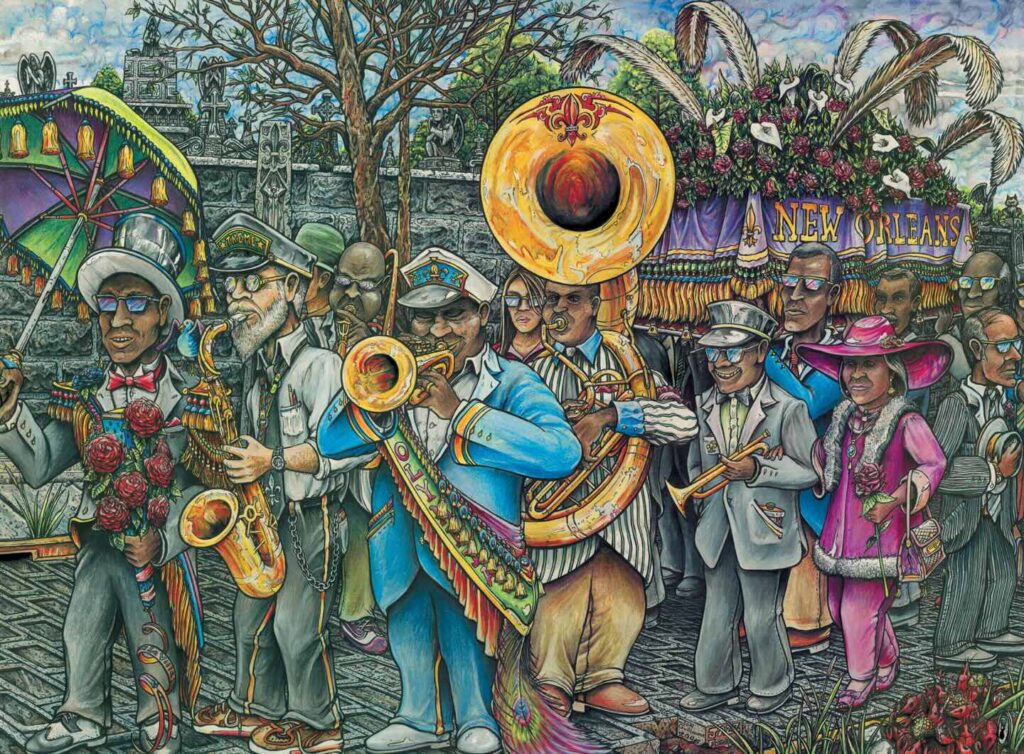
And now we stray into fiction. For truth, I have no idea if this will happen when I plot and write this story, but as I navigate the many warrens in this rabbit hole the idea forms.
Marie is a person filled with joie de vivre. Her husband of decades dies. She doesn’t want a funeral, she wants a celebration! This is who she is. So Pierre gets to his people at the Society, the band shows up at 5PM on June 27, 1855, as the procession is about to step off from home to the cemetery. Although it is not jazz, we have a party… drums, horns. The band plays dirges on the way to the cemetery. When Christophe is put in the ground, the party begins. The quote is talking about an imprecise time not long after the Civil War, perhaps 1875.
“Benevolent and burial societies traditionally arranged these funerals, often offering the services of a brass band for an extra fee. The societies collected dues throughout the year to pay for members’ health care and burial costs. The musicians, funeral directors, family, and friends of the dead make up what is called the first or main line, while the crowd marching behind is collectively known as the second line. As the procession moves from the funeral service to the burial site, the first and second lines march to the beat of a brass band. At the beginning, the band plays dirges, somber Christian hymns performed at a slow walking tempo. After the body is laid to rest, or “cut loose,” the band starts playing up-tempo music, the second liners begin dancing, and the funeral transforms into a street celebration.”
For real, this is a white man, passing as a free person of color so he can live with Marie. She is the high priestess of African heritage. How could this NOT happen? All I’m doing is moving it back in time, say 20 years. This uniquely New Orleans, American tradition had to start somewhere. This doesn’t have to be the first, but I can guarantee you the author will make it the loudest. 🙂
Fiction.