Plus Ça Change – November 8, 2026
“I wish and ordain that my land at the corner of Grands Hommes and Union streets will be forever dedicated and employed for the establishment of a free school for the orphans of color of the Faubourg Marigny.”
The last will of Marie Justine Cirnaire Couvent
For real, Marie Laveaux’s partner Christophe purchased Eliza, an American slave on auction in New Orleans, when Eliza was eight years old. Eliza lived with the family for almost 30 years.
FICTION
Jude is a fictitious character, an astonishingly bright adolescent who I have styled as Eliza’s son, and Marie Laveaux’s chosen grandson. Like his mother, he has a facility for languages, he’s fluent in multiple languages. He is enrolled in Ludger Boguille’s private academy, he is the brightest boy Ludger has ever taught, takes after his mom.
FACT
Teaching slaves is most decidedly against the law. Boguille had a slave as student. When other parents discovered he had a slave as student, they withdrew their sons. To save his livelihood, Boguille expelled the student, but tutored the boy privately afterwards. In my fiction, Jude is this student, but the event is real.
In 1848, free public education exists in New Orleans, but only for white people. Marie Couvent was a free woman of color, and quite wealthy. When she died in 1837 she bequeathed land and funds to create a school for children of color, especially orphans. It is a decade later, the legal battles are over, and a group of men take it upon themselves to make it happen. These men are the core of the Societé d’Economie, a fraternal organization inspired by Marie’s father. Marie knows these men, they were her father’s disciples.
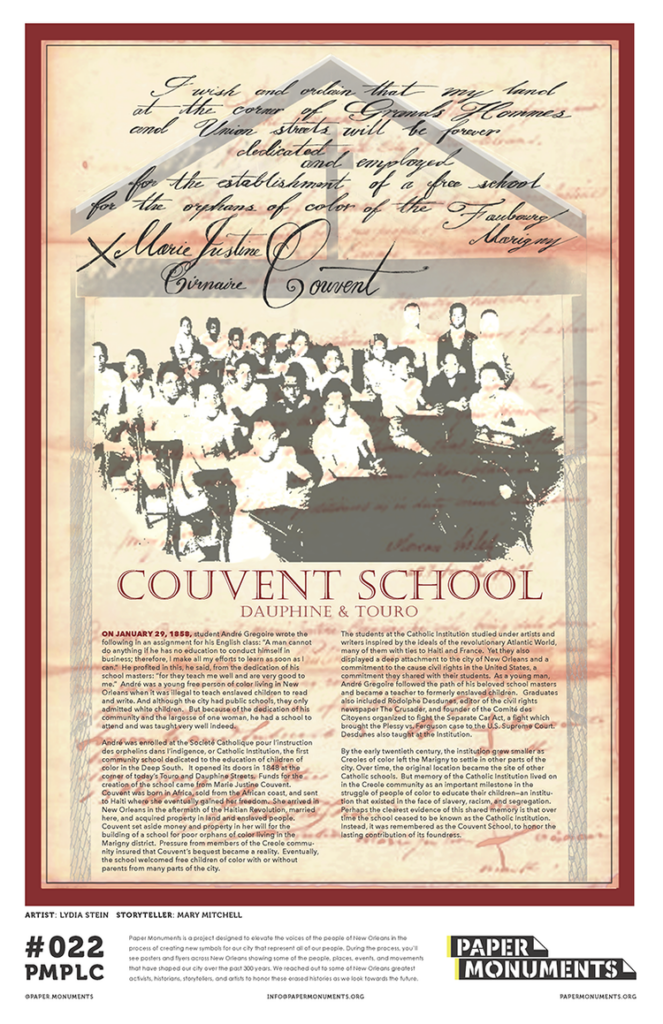
The formal name, in English, is The Catholic Institution for the Instruction of Indigent Orphans. Everyone called it the Couvent School. It opened in 1848, a block away from Ludger Boguille’s private academy. Ludger took a side gig there, teaching French.
The school was remarkable, it survived as an institution for more than 150 years. While it was technically Catholic, any creed was welcome, girls and boys, rich and poor, but all people of color. There was a large student body, and a significant faculty. Most students were orphans and education was free. If there was a parent and they had some means, the cost—even with textbooks—was 20 cents a month. In modern terms, that’s perhaps $5. In later years it increased to 50 cents.
I tracked down a thesis about the school, titled “Nursery of Revolution.” And that fairly describes the nature of this school. It’s not that they fomented rebellion, they believed in education! When you’re talking about children of color in antebellum New Orleans, that is revolutionary. The curriculum included math, science, language, writing, and music, fencing, literature, poetry. This was a genuinely liberal education in the best tradition of free thinking. Why? Because, to the people of color education was the only effective shield against the “spiteful and calumnious (racist) arrows shot at us.”
An example: the students composed letters as a writing exercise. The thesis describes “the school’s curriculum of imagination in which fictive letters provided students an opportunity to construct alternative identities and imagine worlds in which freedom was a reality.” In these letters poor orphans travel all over the world, the Americas, Europe.
But how can I get Jude into this school? The school’s board of directors argued heatedly and repeatedly about educating slaves, despite laws against it. So that allows me, plausibly, to have Jude back in school. This isn’t a dozen or two boys in Boguille’s private academy. This is literal hundreds. In 1852 there were 165 students enrolled, the number of boys and girls being equal. 1853 there were 240 students, 25% of the free children of color attending school in New Orleans.
The directors could (and I’m imaging they did) hide slave children among the student body. There is no evidence that they did. In fact, they probably did not educate slave children, the risks to the school as a whole would have been immense. But…
FICTION!
I need Jude here. He is a special case, and so he will attend this school under the tutelage of Ludger Boguille and other professors. “This is how a proud and free people avenges itself!!”
Now I gotta go write the chapter 🙂 This will be non-trivial.