Plus Ça Change – November 17, 2026
This is an interesting (I hope) look at how I layer a fictional narrative on top of people, places, and events that really existed.
I have an entirely fictional character, Jude Paris, who would be about eleven years old. In 1849 he experiences a flood that drowns the back of the city. For the narrative, I want him to get caught up in looting. He’s a kid, he doesn’t know what he’s getting into, he gets sucked into being a lookout for burglars, who take a skiff to abandoned homes and steal valuable goods left behind. . I want him captured, and subject to severe consequences for his naiveté. This will become a significant input into Jude’s character, and helps drive the story. This has been in my plot outline for a long time.
I had to do a lot of research into this, to get the background right.
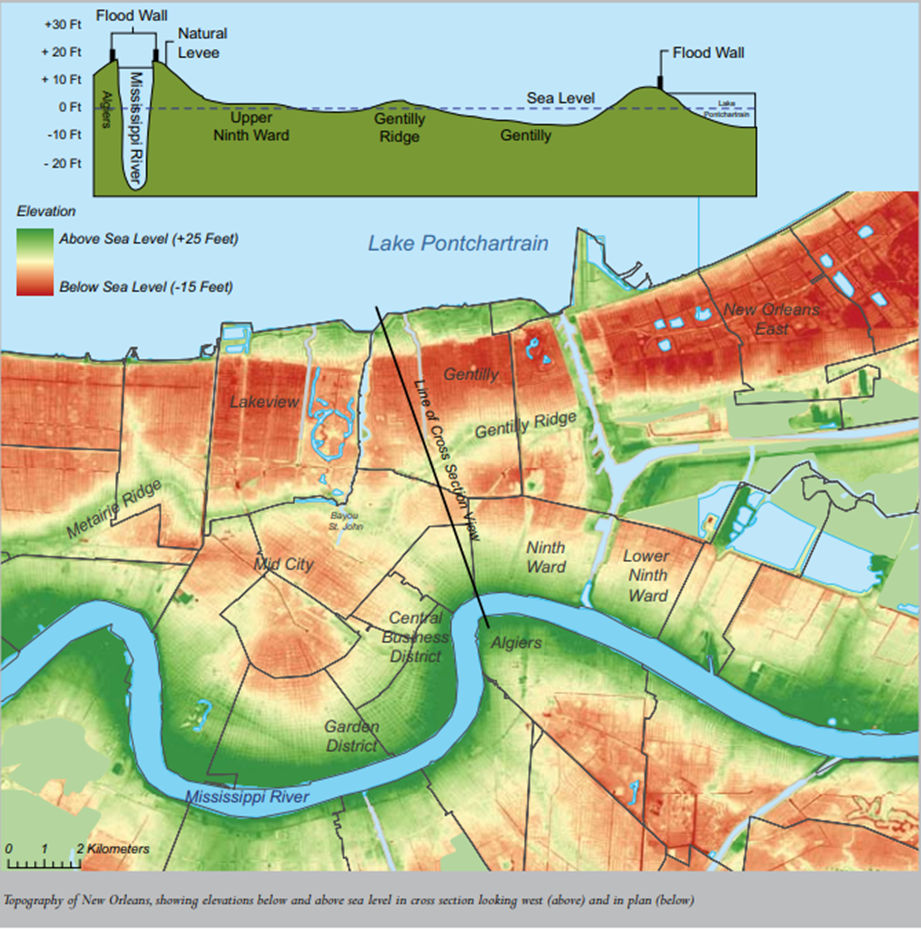
Counterintuitively, for most of the city of New Orleans, the Mississippi River is uphill. There is a natural levee created by sedimentation deposits when the river floods. The graphic shows a modern elevation. In the early 1800s it was a bit better, but nonetheless still essentially a bowl. The geological processes behind that are intriguing. Much of New Orlean’s history results from this slope.
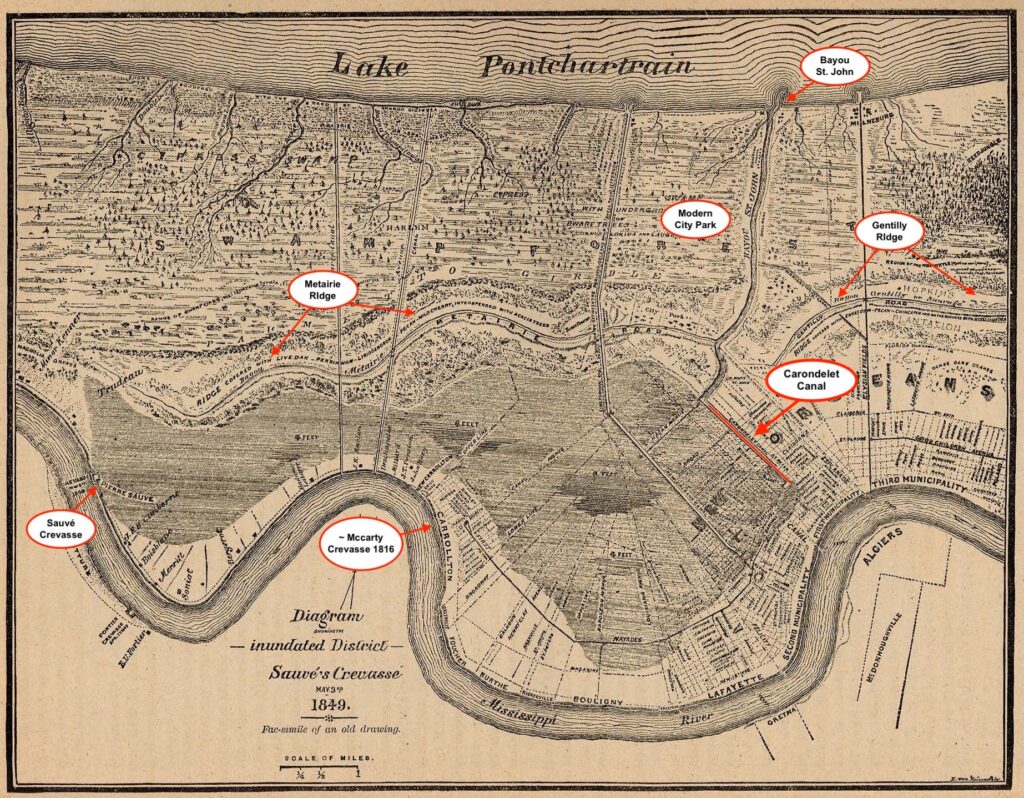
On May 3, 1849, the river breached the levee on the Sauvé plantation, about 18 miles upriver (9 miles direct line) from New Orleans. The resulting inundation covers square miles with water up to six feet deep. It flooded hundreds of blocks within the city. At least 12,000 people were displaced. It was the worst flood in the history of the city until Hurricane Katrina.
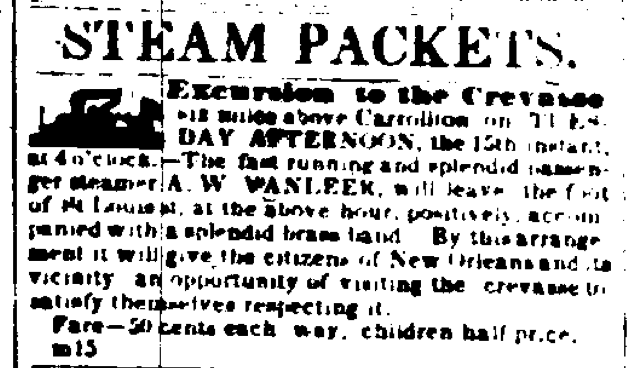
The crevasse was a tourist attraction. An enterprising steamboat operator took passengers upriver to see the breach, accompanied by a “splendid brass band.” The fare was 50 cents each way, half price for kids.
The flood, the areas flooded, the dates, the depth of water, the “stuff” floating around in the water, that the bank of the Carondelet canal bank was a dike, that a steamboat ran tours up to see the breach, the fare for same, all real. It was mostly the American district (a separate city at the time, the Second Municipality) that suffered the flood. Into the warren of houses behind the Charity Hospital we go. There’s a cemetery nearby, the Girod Street (aka Protestant) Cemetery. That Jude sees a coffin floating by, fiction but that’s the kind of stuff floating around. One illustration, likely of this flood, shows a man paddling a pirogue among the tombs of the Girod Street cemetery. I like that visual, so I want this scene to happen in a silent, flooded city, next to this cemetery.
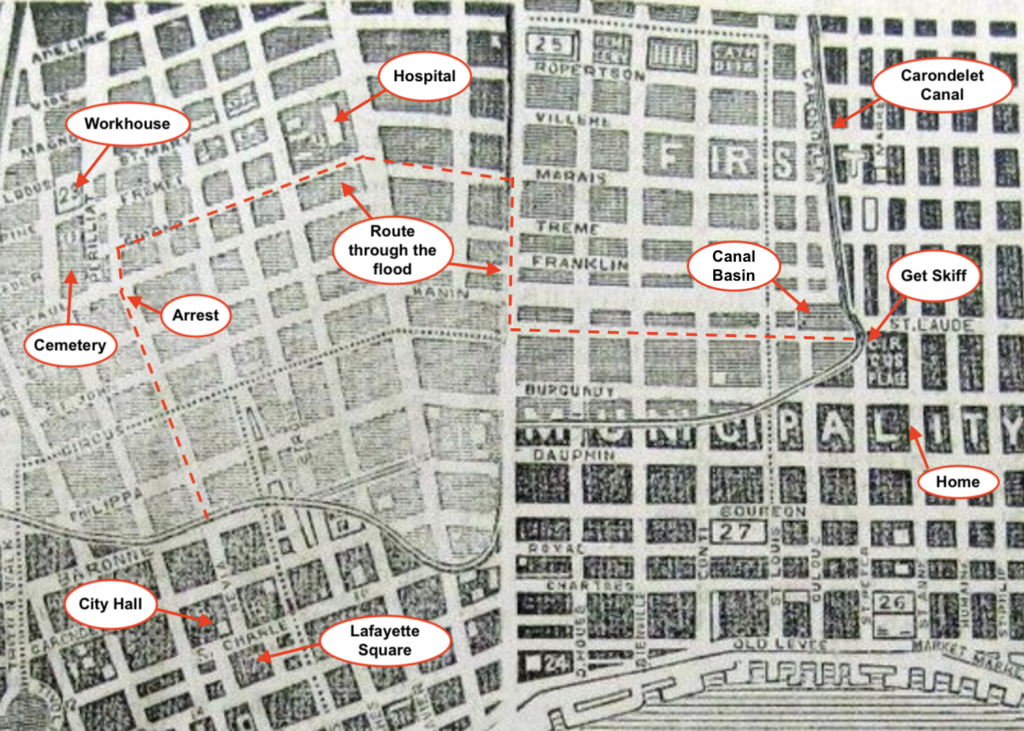
Research says, this isn’t a particularly wealthy part of town, it’s Irish and German immigrants. So research has me stomping around the 180-year-old past looking for what the street names really were back then, what it might have looked like. In the 1846 city directory I find this:
Winters, J. Captain of the 2 m. guard, Hevia b. St. Paul
Winters is captain of the Second Municipality City Guard, and he lives on Hevia below St. Paul. Smack dab in the middle of my target. It’s across from the cemetery, a block down from the workhouse, a straight shot to city hall, and all in the flooded district. He shoots, he scores. FICTION: The burglars think the house is empty. Captain Winters is asleep, he is commander of the night watch. The two burglars escape, Jude, sitting in the boat, is arrested.
TODAY: The Superdome and the Hyatt Regency Hotel are on this location. It all once was, and is no more. I like bringing it back to life.
This was a chapter about consequences. And crafting this has consequences. This chapter, and the events that feed the narrative, are long standing items in my plot. What comes next, the actual result of the arrest, the criminal “trial” and the series consequences… well, Captain Winters looked at me and said, “You think you’re gonna get away without writing that?”
And he’s off.