Plus ça Change – May 13, 2026
I have an underlying theme that Marie experiences throughout her adult years in New Orleans. The Americans bought the territory in 1803. That started a culture war that lasted for decades, and Marie lived through it. As always there are exceptions, but the center of the bell curve is that the American attitude toward people of color was hideous. It got worse and worse over the decades. Toward the end, many free people of color who had the wherewithal to get out, did. They went to Haiti, or Cuba, to places where there was no slavery. Americans abandoned their country because of racial oppression.
This was very much gradually raising the temperature on the water until the victims boil to death. Marie lived through that, and never left. Marie is bright, she knows this is happening, and she stays because this is home, and she’s needed here.
I’ve been chewing on the next chapter for a week, trying to craft it within the strictures I have set myself. It has to reflect this overarching theme. It has to be historically accurate. It must be personal, human. It has to be narratively compact. It has to have good local color. I have to drop you into this environment so you feel what Marie feels, what Eliza feels. Because…
History.
In March 1830 the Louisiana legislature passed bills relative to the presence of free persons of color (FPoC) and slaves in their state. The governor signed them into law on March 16. The French and Spanish had slavery, but not like this. It got worse as the years went by, but in 1830 we have…
- Any FPoC who arrived after Jan 1 1825 has 60 days to leave the state
- Any FPoC who arrived before then must register with the state/city
- No new FPoC may arrive from outside the state
- Any emancipation within the state requires a $1,000 bond and removal of the newly freed person within 30 days
Marie was an FPoC. Her common-law husband Christophe pretended to be so he could live with her. In no small way, the government was after them. They own a slave, a young girl (10) named Eliza. They bought her on March 14, 1828.
- It is a death penalty offense to say or print anything having a tendency to produce discontent or insubordination among slaves or FPoC.
- A year in jail for teaching a slave to read or write.
Several of these, as reflected in the cultural tendencies of the time, are in the narrative. The last one is the subject of this chapter. Girls in New Orleans went to school. The literacy rate among women in New Orleans was higher than among men; white or people of color. Education was prized. But it was all private, there were no public schools yet. “School” was someone’s parlor, with desks, and the children lined up feet flat floor to listen to the schoolmaster.
Fiction
I’ve set this up such that Eliza is a member of the family, nanny to the toddler Heloise. She is a slave, but Marie treats Eliza as a daughter. They have no idea when she was born, so they treat March 14 as her birthday. Eliza is very bright, she has an easy facility with languages. She speaks at least four. Marie wants her educated. Eliza knows how to read or write. Marie does not, she’s illiterate all her life (fact). Most of my thrashing about this chapter has been to figure out how Eliza is schooled. And therein, a chance to show you places where the story does not go.
The time is March 14, 1830, and it is Eliza’s birthday party. This is where/when she finds out that because she is a slave, she will no longer receive a formal education. This is a formative moment in her young life.
School #1: the convent school run my the Ursuline nuns. This is in Dancer, it’s where Marie never got to go, because she’s not an orphan and Gran Catherine doesn’t have the money. BUT… by 1830 the nuns have moved to a location three miles downriver. There would be serious “send a little girl walking past the docks” problem. Nah.
School #2: Complete fiction (although there was someone in history who matches); a former nun has set up shop to teach young girls of color. Young boys would never be taught by a woman. White girls already have educational options. There are plenty of wealthy people of color who can pay to have their daughters educated.
There my plans sat for a while, but I’m not happy. I have to introduce, however briefly, a new character, all the backstory, the “logistics” of her showing up in the middle of the party. For “some reason” this woman arrives to tell Marie that she’s throwing Eliza out of school because she is a slave? I don’t have that worked out when idea three arrives.
School #3: Ludger Boguille is Eliza’s tutor. He is already planned as a significant character. He is an historical figure, was a teacher, one of the founders of the Societé d’Economie mutual aid society, and for years its secretary. For real, he opened a school a few years later. In 1830 he is 18 years old.
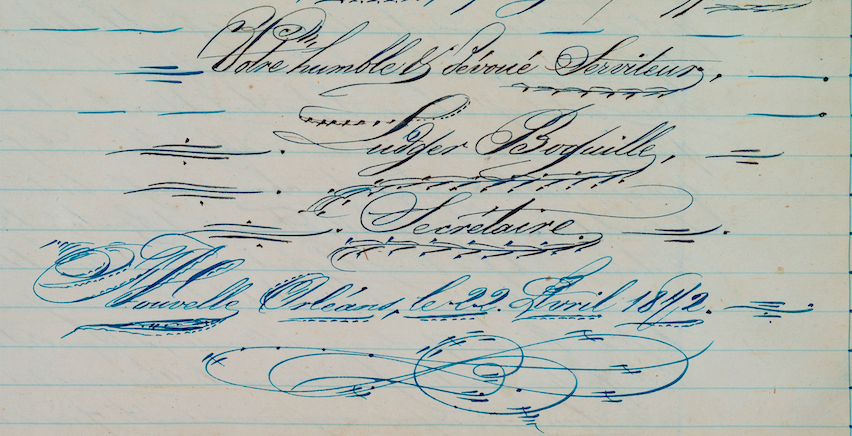
Fiction: I have him crafted as one of her father’s political acolytes. Marie has hired him to be Eliza’s tutor (she knows the boy well) because the convent school (the only option for a girl) is too far way.
And I have the historical girder upon which I can build the fiction. Ludger is a family friend. He’s invited to the party. It’s logical he’s there. He’s politically very astute. He knows what’s going on in the legislature. He also has a very bright future to consider, and he doesn’t want to go to jail. So the conversation becomes, essentially, we are in the shit, I can’t continue, but… they can plan. Christophe can take on the task, Ludger can provide materials and guidance. They can resist the oppression, as long as Eliza keeps quiet about what’s happening inside the house. And therein, the little girl’s introduction to the consequences of the slave culture. Her tutor goes away, replaced by ersatz Dad, and she has to lie about it or Dad goes to prison.
I don’t have to introduce a new character or backstory, it’s already there. And I get to enrich your understanding of what makes Ludger tick, which will work nicely downstream. For real, Ludger quietly resisted the oppression of his people. And I can set up this aspect of his character in this chapter.
All right, says writer boy. I got no more excuses to duck this chapter. 🙂