


Plus ça Change – April 28, 2026
So, I’m walking with Marie down to the waterfront where she is going to see her sister Dolores off. Dolores is on her way to live her life in Paris.
I know where ships docked on the waterfront. A map from the time shows “finger” style docks poking out into the river. Illustrations from the time show the tall ships bow to the bank. So this is all wonderful, consistent. I’ve got points to make, a story to direct, but then this happens.
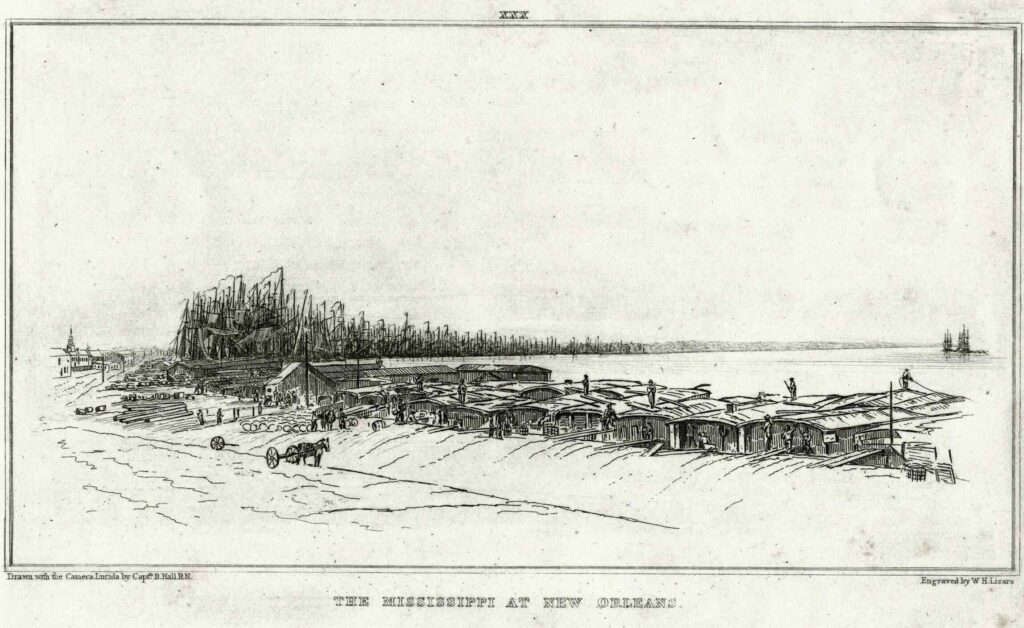
There I am, dockside, writing about the parting of Dolores and Marie when, says I to my self, “How the hell do they get a sailing ship out of a dock?” Because that’s what is happening, and I have ZERO idea how it happens.
Precision is not a feature of moving a tall ship around using wind power. This is long before tugboats. There are no motors here. Steam engines on ocean-going vessels were decidedly experimental. So how did they do it? And how did they dock in the first place? There must be “stuff” to describe, sights and sounds. I learn.
Docking: you had to get a line from the ship to the dock, one way or another. In this case, a tall ship inside a river, I’m guessing they would anchor and send over a skiff to carry the line. Once attached to the dock, sailors on the ship would haul (likely with a capstan) to pull the ship into the dock and then moor it. This process is called warping, and it was not light-speed. It was slow and (literally) laborious.
To get out of the dock, it’s the reverse, the process is called kedging. You take an anchor out some distance in the direction you want to go, you drop the anchor so it’s secured on the bottom. Then you haul on the line to pull the ship to the anchor. Lather, rinse, repeat until the ship is where you want.
Sailors probably know this. I am not a sailor, nor have I ever pretended to be. But I’m standing dockside and I have an inquisitive mind. It’s 1829. I need to see how this works, and there’s this massive blank spot in my vision. How does this work without motors?
Great fun learning a new trick. So, I’ll go back to the chapter. I can pretty much guarantee that the word “kedging” will NOT show up. Because normal mortals have no idea what kedging is, so I’ll keep that to myself. Probably. Maybe I’ll end up defining it in place, but probably not. It’s a term of art, and the art is sailing. My goal is to tell a story, not confuse you.
But I can describe, I can make it real, and the morning’s hunt might add a sentence or two to the narrative, if that. But I now know what kedging is. So do you. 🙂


I started a comment about kedging/warping that promptly got gobbled up unfinished. What I was working up to….I once had a book by the Sabine Pilots Association, printed early 20th century on navigating twisty rivers by large ships, including sailing ships. There were crazy diagrams of warping, springing, kedging, sailing a large sailing ship upriver. Will look for it online. Iolo