Plus ça Change – May 1, 2026
Pantsing has consequences. I didn’t know who what when where why, but I expected something like this. I’m sure it’s going to happen again.
At this point in the narrative, Marie’s father, Charles Laveaux, is a widow. His wife had money. She was Marie’s stepmother. When the stepmother died, daughter Dolores sued her father claiming he defrauded her of her mother’s wealth. All that’s history.
Pure fiction, I’ve set it up so that his wife, Marie’s stepmother, resents Marie. But the stepmother is dead. Has been for five years. I’ve had Marie’s relationship with Dad improve. He really does like his daughter, but the wife got in the way and he let that happen. I need to rationalize in the narrative how he’s resolved the legal dispute with Dolores, so that’s in the back of my mind.
Real history. Shortly after Charles Laveaux died, several younger men got together in the back of his old grocery store and founded the Economy and Mutual Aid Society. That happens down the road a bit, but I know it’s coming. My curse is that I write within the lives of people who really lived, and really did things. I need to make reality into compelling fiction.
I have a fabulous nonfiction book about that organization and its storied history. Economy Hall: the Hidden History of a Free Black Brotherhood by Fatima Shaik. The book is hugely informative, and the real stories told will feature in my fiction. It looks like Marie’s father (VERY plausible) was the inspiration for the Economy society. That’s been in my mind for a long time. Good.
But, says fiction-boy, how do we work this into the story?
In the narrative where I am, Marie’s sister Dolores (whose arc is a Must-Happen and the result of pantsing) is getting on the boat for a new life in Paris. The two half-sisters share Popa, and he’s there as well, of course. So Marie walks home with Dad. There will be a conversation. A father-daughter heart-to-heart. It’s a big moment. And as I imagine that, what are they talking about, it flows but I don’t like it.
Would they snipe at each other over politics? Maybe to a degree, but dissatisfaction has me thinking. I have already had him focus on politics, to be the inspiration for his followers. But it’s not well defined. I had his belief system as reverse racism, that the Black man is superior to the white. That certainly doesn’t comport with how I define Marie, and that’s the source of my unhappiness.
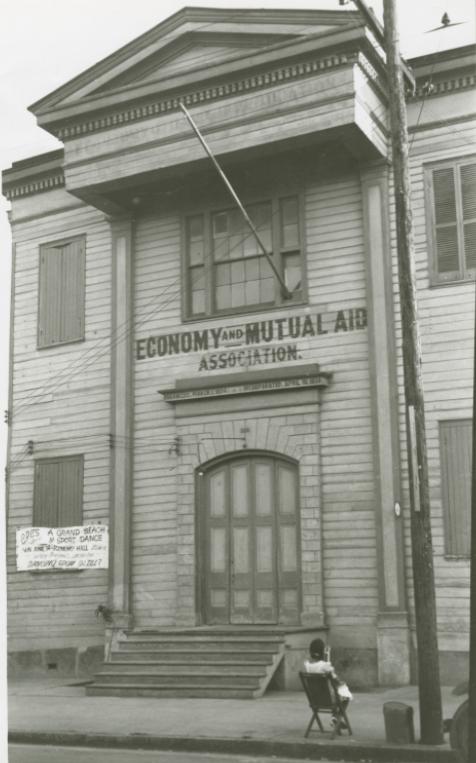
Then, I think about the name of the organization created in his memory. In French it is the Société d’Economie et d’Assistance Mutuelle. In translation, on their own building, the Economy and Mutual Aid Association. It is not “economic mutual assistance,” it’s “Economy and…” At the time, the word meant both the economic system, and the management of household or private affairs.
On the face it’s how to help each other at a household level. But it’s also, what do we do about the oppressive society we live within. I imagine his focus is how free people of color could prosper. If he’s the inspiration, his political focus is as much economy as it is race.
Being a very bright and successful business man, he draws the parallels between slaves and immigrants. I can work his growing understanding into the resolution of his problems with Dolores. As he divests so that he can give her an inheritance, he realizes he’s a tool. He’s a Marxist before there was Marxism. AHA! This is, of course, complete fiction, but that’s what I write.
I assume the society is modeled initially after his thinking. There is a substantial element of Black pride, they were the home for the elite of the free Black community. Steep entry fees, and monthly dues. But racism, it turns out, is a vehicle for a broader economic oppression. This fits perfectly with what I know about the economy of New Orleans and Louisiana.
In the countryside, white planters, mostly French, grew cotton and sugar cane on the backs of slaves. In the city, slaves were either household servants, or owned and jobbed out for wages as skilled workmen, an economic investment. The slave trade was massive, slaves were valuable, and very expensive to own. The slave owner had to feed and house his slaves.
In the burgeoning factories, digging canals, building railroads, the capitalistes (mostly American) hired immigrants. They were dirt cheap, easily replaced when they died of fever, and they paid for their own room and board out of the pittance in wages. It really was hire and forget. The population of New Orleans boomed, and it was mostly European immigrants.
Sometimes the writing gods are good. The english word “capitalist” shows up right around 1800, from the French “capitaliste.” So it’s a French concept that makes it into English. Which, for me, is perfect.
From the point of view of economic oppression, the parallels between chattel slavery and wage slavery are huge. And that is where I’m going to take Popa. To the capitalists, people are irrelevant; profits relevant. Racism fits nicely into that economic context.
Popa’s followers will create the ECONOMY and Mutual Aid Society. Most of that storied organization’s history is beyond the time of this novel. But who they were, and what they did, was absolutely awesome. They built a lovely meeting hall and rented it out. Economy Hall was a music venue, and one of the foundational homes of jazz. “When you made Economy Hall, you was tops. It was just like you was playing at that big place… Carnegie Hall.”
They didn’t build the meeting hall until near the very end of my novel. They owned a small house across the street they used for meetings, and their library. But as an organization they did massive good.
So now I need to refine Popa’s well-dressed philosophies, drop in the principal tenets in the right spots, both upstream and down, make notes for a couple of future chapters, and (mostly but not entirely) keep them OUT of his conversation with Marie as they walk home from saying good-bye to Dolores. That should keep me out of trouble for a little while.