Plus Ça Change – September 13, 2026
I write fiction built on historical fact. Sorta. My favorite aphorism about historical fiction authors: we owe allegiance to the truth, not the facts. The story must be true, but the specific details may not be historically precise. Nonetheless, sometimes the foundational reality of the time—words, events, attitudes—might not conform to modern sensibilities. I’m looking at one of those now.
I am at that point in the narrative where Pierre Crocker becomes a member of the family. Should Marie be upset because her 16-year-old daughter Heloise is shacking up with a 40-year-old married man in 1843?
Within the culture of the times, the idea of a rich man having a mistress was pretty widespread. Pierre Crocker was a wealthy free man of color. He was married to Rose Gignac Crocker, with several children. He had a long-term relationship with Heloise Euchariste Glapion, daughter of Christophe Glapion and Marie Laveaux. Pierre and Heloise had several children.
The details of their life together are pretty vague, so I have a lot of leeway in terms of fiction. But I wanted to check his behavior against my 21st century sensibilities.
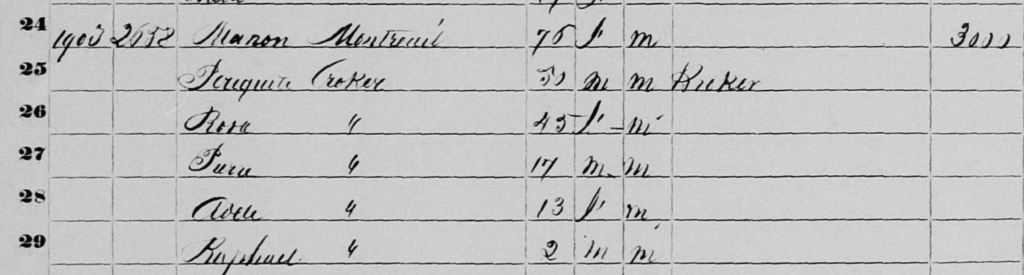
The only relevant document I have is the 1850 census. The census lists Pierre in the home of his mother-in-law Manon Montreuil, along with Rose and their children. One of whom, Myrtille Raphael, was born after he established a relationship with Heloise. In the 1850 census, Heloise is listed with her mother, Marie Laveaux, along with her children by Pierre.
Pierre was well off. He declared bankruptcy the year before, overextended in real estate speculation (maybe). Christophe Glapion managed the disposition of assets (probably). It is quite likely that Pierre was a follower of Marie’s father. He was one of the founders and first president of the Societé d’Economie, which was (probably) inspired by her father’s beliefs. So he’s almost a member of the family already.
Pierre committed suicide in 1857. He wrote a suicide note, a love letter of sorts, addressed to Heloise and her family. He does not mention Rose or his children with her. I ran across this a couple years ago, The Human Heart. But Rose is buried with him, not Heloise. Heloise was likely buried in the Laveaux family crypt.
Any number of explanations for these facts is possible.
Perhaps he continued to live with his wife, and had Heloise as a mistress. He had two families simultaneously. Perhaps he left his wife (remaining married because of the culture of the times) and moved in with Heloise. Rose could have a fling, resulting in Raphael. Perhaps Pierre and Heloise had a fight, so in 1850 he was temporarily back with his wife. Or, all of this is perfectly above board, Pierre and Rose have a mutual agreement to stay married but live apart, and when the census shows up Manon or Rose maintain the fiction that Pierre lives at the house. Raphael could be someone else’s son, but Pierre, being honorable, says “he’s mine” to protect both the boy and Rose. Did Pierre have an unhappy marriage? Is Heloise a home wrecker? Is he smitten with a cute young thing and abandons all reason? Is he a pig with a cute squeeze on the side? Or is he following the human heart?
But, I can’t ignore him, so off we go into the relationship. Because the fact is, although there was no marriage, he was a member of the family and, downstream, does great good for the family after Christophe dies.
So, all that takes us back to figuring out how I’m going to deal with this relationship in the narrative, and is Marie pissed off at her daughter for being with Pierre?
The answer to pissed off is, no she’s not. She’s a practical woman, her daughter is in love with the man. He’s an honorable man, who provides for both his families. I can have him move in with Heloise, but he doesn’t abandon his responsibilities to Rose. In addition, Marie lives with a white man who is twelve years her senior. So can she complain about a twenty-four year difference with a man of color? She could but it’s going to be a better narrative if she does not. Pierre hooked up with her daughter, and remained a family friend. That’s a fact.
Life is complicated.