In The Flow of Time – August 27, 2024
All y’all may need to organize an intervention. I’m plotting the novel. I’m not even sure this chapter will make it in, but I like it. It’s got color. It is in 1815, inside the St. Louis Cathedral in New Orleans. That building has been seriously rebuilt again and again. It’s quite lovely today. But, 200 years ago…
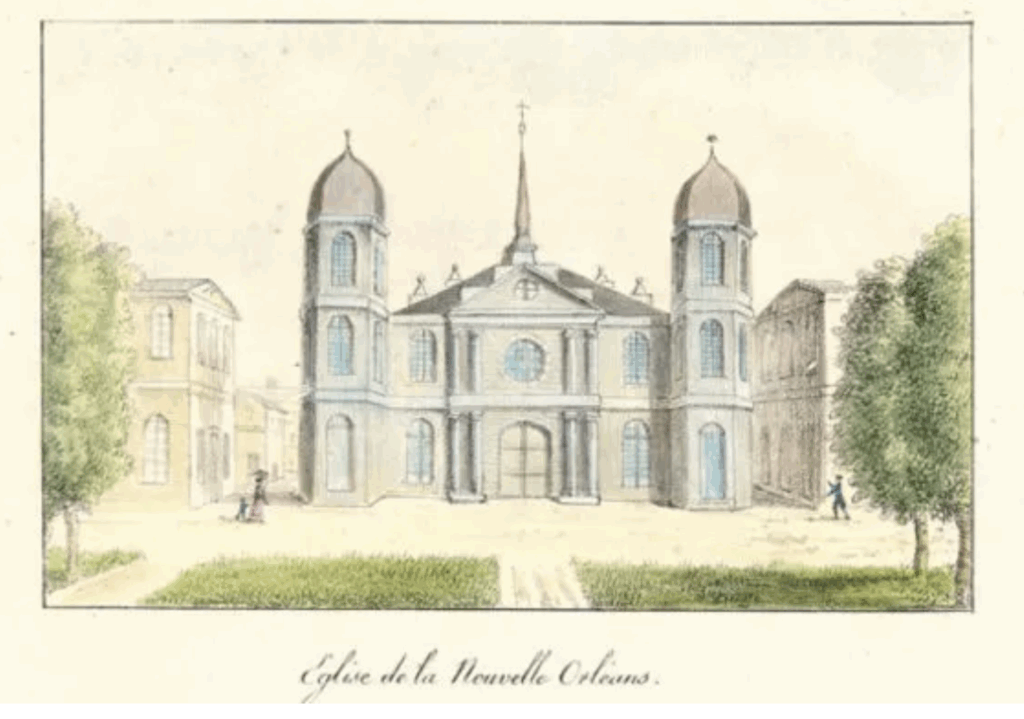
What did it look like in 1815? Did it have a central tower? It did not. A clock? Maybe.
Is there an organ? How about the interior? What is the vaulting like? Are there side chapels? Extra altars? To whom? Where? Are there pews? Chairs? Open space? What’s the floor like – wood, dirt, tile, brick? How am I going to answer questions like that from this remove, hundred of miles and hundreds of years away.
The answer is the indefatigable Benjamin Latrobe, architect and man about town, who kept a journal.
The organ? “One of my motives for going to the Cathedral was the hope of hearing good & affecting church music. In this I was most sadly disappointed. There is no organ; at least the miserable organ which they have was not played.”
On one occasion he discusses candles, and I learn about altars. “Among these devotional practices, that of vowing & presenting lighted tapers at the Shrine of the Virgin, or of St. Francis, to whom the side altars are dedicated, & even at the foot of the great altar, is very conspicuous.” He goes on about how and where the candles are made, what they cost, and the likely profit to the church from this devotion.
On another occasion… “I observed an old black woman, by herself before one of the altars on her knees, & her body bent to the earth. She had drawn away her cloaths [sic] from under her in such a way as to kneel on the bare bricks, which are exceedingly rough & broken.”
Were there pews in the church? He stopped in on April 4, 1819, Palm Sunday.
“Only half the nave & half the aisles of the Church is pewed, & many of the ladies that were going to Church were followed by servants carrying chairs after them, so that about1/3 of the congregation were in pews, 1/3 seated upon chairs in the open spaces, & the rest standing. The Church was exceeding crowded, & calculating 1 1/2 feet square to each individual, not less than 1,500 persons can have been present.”
All so that I can, in passing, describe the scene. The reader knows nothing about any of the above. I’m happy that I know, as best I can, that if I write this scene, it will be accurate for 1815.