Plus Ça Change – November 4, 2026
There’s plotting, and there’s pantsing. I plotted and wrote a chapter involving Marie’s purchase of Juliette, a slave. And that led to a completely unplotted chapter. I love it when that happens, the characters are talking to me, making it abundantly clear that X is worthy of our attention.
Over the years that they lived together, Marie Laveaux and Christophe Glapion owned slaves named Eliza, Molly (and her two boys), Juliette, and Irma. We have no idea what Christophe and Marie were like as slave owners, but they were. Irma is not in the narrative. Eliza and Molly lived with the family for decades. Juliette was a runaway.
I decided a really good vehicle (in the plotted chapter) is Marie repeating her “rescue” of Eliza. Eliza, for real, was eight years old when Christophe bought her. To make this new scene work, the purchase of Juliette, I added Dr. Jean Montanée to the auction (complete fiction). Knowing that Juliette has a history of running away, Marie “rescues” Juliette from becoming part of his harem. (he really had one). The problem is, Juliette is not a little girl, she’s a grown woman and doesn’t need to be rescued. And therein the birth of a new chapter.
In history, Christophe and Marie bought Juliette twice. She ran away both times, they found her and sold her both times. Christophe’s original purchase of Juliette is not in the narrative, only the second purchase by Marie. That was the chapter I plotted. It is a historical event. And when I was done, Juliette spoke up. “Imagine what it’s like to be me.” Pantsing!
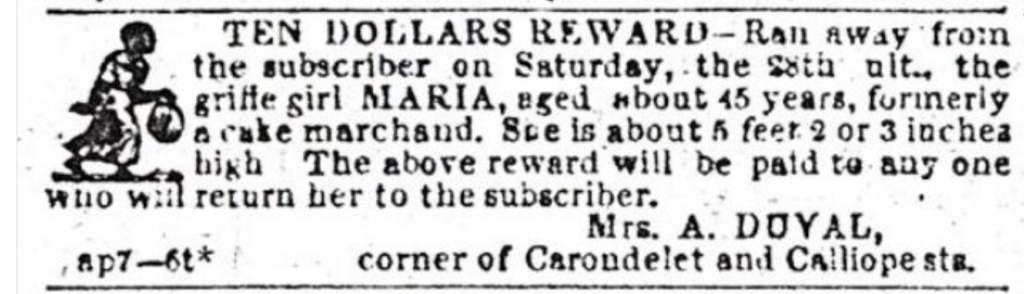
In the way of things, I realize that these circumstances give me an opportunity. That Juliette appears in the mix is a chance to explore yet another aspect of slavery. These women were not purchased to emancipate them. They lived with and worked for the family. Because slavery was normal. How these women—Eliza, Molly, Juliette—feel about being slaves is a worthy exploration. As writer-boy, what I most definitely need to avoid here is preaching. It needs to be authentic, normal, ordinary daily life. I think I got it.
In the narrative Juliette runs away and disappears. In history, she runs away and is discovered. The free woman of color with whom she was hiding/living didn’t know she was a slave. After discovery, Marie sold Juliette to a friend, getting her money back. I plotted that event. Now, I have no need to write that. We’ll let Juliette run away. Because that’s what it was really like. This is yet another place where I can sacrifice cold fact for warm truth.
Harriet Tubman was a runaway.